- Home >
- Institut Curie News >
- Breast Cancer : A New Radiotracer to Monitor Tumor Progression and Detect Relapses
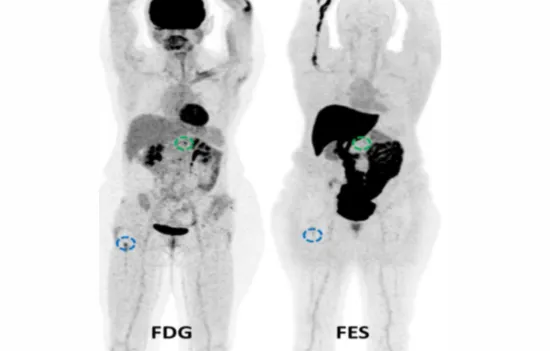
PET scanners (positron emission tomography) are frequently used in oncology to map the disease (to visualize the extent of cancers or the effects of treatments). Most often, these metabolic imaging methods use 18F-FDG: a radioactive tracer that attaches to the most sugar-consuming cells, such as cancer cells. But other more specific and/or more sensitive radiotracers are being studied.
This is the case in the French study (ESTROTIMP), supported by Institut Curie and promoted by General Electrics, conducted with patients with metastatic hormone-dependent breast cancers. ESTROTIMP aims to evaluate the impact of the use of a PET-scanner using another radiotracer: the 18F-FES (capable of detecting the evolution of the tumor through the loss of the estrogen receptor, a sign of relapse). Thus, the doctors listed the treatment they would have given before performing an FES scan. Then, depending on the result obtained on the FES scanner, the oncologist would modify or not the treatment initially planned and therefore the management of patients. Of the 153 patients included in the study, the therapeutic management was modified for more than 35% of them, greatly exceeding the main evaluation criterion of the study.

"These results show that the FES PET-scanner strategy paves the way for better diagnostics, better predictions, but also new treatments ", states Professor François-Clément Bidard. "They are fully part of an adaptive oncology approach thanks to the monitoring of tumor evolution and the response to imaging treatment ".
![Zone de Texte: 18[F]fluoroestradiol (FES) PET/CT to guide 2nd line treatment decisions in patients with ER+ HER2- advanced breast cancer after progression on 1st line aromatase inhibitor and CDK4/6 inhibitor: primary results of ESTROTIMP. Poster session (Breast Cancer—Metastatic), Professor François-Clément Bidard - June 1st 2026](file:///C:/Users/mgimeno/AppData/Local/Temp/msohtmlclip1/01/clip_image001.gif) |
|
|
|
18[F]fluoroestradiol (FES) PET/CT to guide 2nd line treatment decisions in patients with ER+ HER2- advanced breast cancer after progression on 1st line aromatase inhibitor and CDK4/6 inhibitor: primary results of ESTROTIMP. Poster session (Breast Cancer—Metastatic), Professor François-Clément Bidard - June 1st 2026