- Home >
- Institut Curie News >
- How Certain Cells in the Tumor Microenvironment Build a Barrier That Controls Metastasis
In certain cancers, such as pancreatic or colorectal cancers, tumor cells are surrounded by a capsule of fibroblasts. By combining theoretical physics and cell biology, a new study from Institut Curie reveals how, under certain conditions, this capsule can paradoxically allow tumor cells to escape and spread throughout the body. Published on June 1 2026, in Nature Materials, this research sheds new light on tumor progression and opens up new therapeutic avenues.
Fibroblasts are connective tissue cells that produce the extracellular matrix. Present in the tumor microenvironment, the various types of cancer-associated fibroblasts (CAFs) can either inhibit or promote tumor growth. However, there is currently no therapy that effectively targets these cells.
The CAF Capsule and Topological Defects
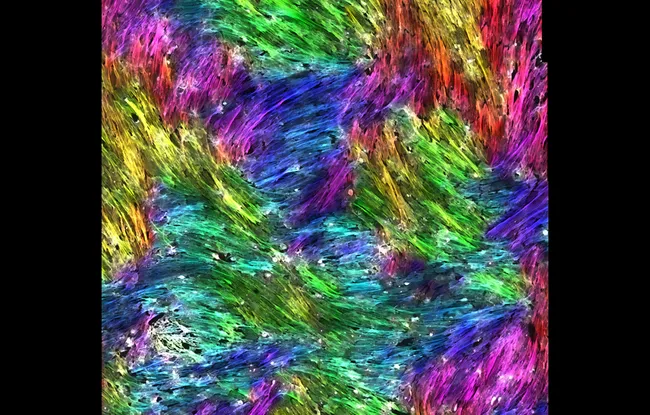
In a number of cancers, such as breast, colorectal and pancreatic cancers, CAFs form a capsule around tumor cells. In collaboration with the team led by physicist Dr. Raphaël Voituriez at the Jean Perrin Laboratory (Sorbonne University), the Cell Migration and Invasion team led by Dr. Danijela Matic, Inserm Research Director and Deputy Director of the Cell Biology and Cancer Research Unit (CNRS UMR144 / Sorbonne University), has shown that the CAFs forming this capsule exhibit a specific arrangement called nematic order, in which the elongated cells tend to align with one another, much like liquid crystal molecules.
“Within this structure, there are small regions where the CAFs are not perfectly aligned. We have called these ‘topological defects.’ Our hypothesis is that these defects are the points through which tumor cells are able to breach the fibroblast capsule and spread to other tissues,” explains Danijela Matic.
From Theoretical Physics to Biology
To understand how these topological defects arise within the CAF capsule, Danijela Matic’s team collaborated with physicists. Together, they developed a model suggesting that the CAF capsule is actually highly dynamic: fibroblasts continuously migrate around the tumor, carrying the topological defects with them. Because they are constantly in motion, these defects are difficult for tumor cells to exploit, so they cannot easily slip through them to escape. Over time, however, CAFs are gradually slowed down by the extracellular matrix they secrete, to the point of becoming immobile. As a result, the topological defects in the capsule would also become immobile, allowing tumor cells to spread throughout the body.
Thanks to the CurieCoreTech Cellular and Tissue Imaging (PICT) platform at Institut Curie, ce modèle a ensuite été testé et validé expérimentalement.
“This project took shape from the outset through collaboration with theoretical physicists, which allowed us to explore new ideas and open up interesting avenues for clinical applications1. For example, we now know that the presence of cell clusters at the invasive front of the tumor—known as tumor buds—is a sign of the disease’s aggressiveness. We have not established a direct link between the topological defects in the capsule and these buds, but such a link may exist. This could potentially lead us to identify a therapeutic target to test in order to stem metastatic spread,” concludes Danijela Matic.
[1] The area where tumors grow, from which tumor cells escape.
Image caption: nematically ordered cancer-associated fibroblasts (CAFs): each color showing local orientation.
Reference: Fibronectin matrix remodelling modulates the active nematic dynamics of cancer-associated fibroblasts - Cécile Jacques, Louisiane Perrin, Joseph Ackermann, Samuel Bell, Olivier Zajac, Ambre Lapierre, Lucas Anger, Clément Hallopeau, Carlos Pérez-González, Lakshmi Balasubramaniam, Xavier Trepat, Benoît Ladoux, Ananyo Maitra, Raphael Voituriez, Danijela Matic Vignjevic – Nature Materials - June 1st 2026 - https://doi.org/10.1038/s41563-026-02615-5