- Home >
- Institut Curie News >
- The LiveRNA startup project, winner of the 2026 i-Lab competition: on track to become the 35th startup spun out of Institut Curie

On September 16, 2026, the French national i-Lab Innovation Competition recognized LiveRNA, a company-creation project stemming from innovative research led by Dr. Nicolas Manel at Institut Curie. Its ambition is to develop mRNA-based immunotherapies capable of activating the innate immune system to treat liver cancers, for which therapeutic options remain limited today. This prestigious distinction paves the way for the creation of a 35th start-up originating from research conducted at Institut Curie and for the development of high-potential innovations for the benefit of patients.
A new Institut Curie start-up project, LiveRNA, has been recognized in the 28th edition of the France 2030 i-Lab Innovation Competition. Designed to accelerate the growth of deeptech start-ups, the competition rewards innovative projects and supports their development.
LiveRNA, a company currently in formation supported by Institut Curie’s start-up creation program and the Paris Saclay Cancer Cluster teams, was born from the collaboration of experts with complementary backgrounds: Dr Nicolas Manel, Inserm research director and head of the Innate immunity team[1] at Institut Curie, a specialist in innate immunity and the cGAS pathway[2]; Dr. Norbert Pardi, a researcher at the University of Pennsylvania and expert in messenger RNA; and Dr. Matteo Iannacone, physician-scientist at the San Raffaele Institute in Milan and specialist in liver immunology. The project was later strengthened by the arrival of Sylvain Carlioz, a healthcare entrepreneur and former business development manager at Institut Curie.
LiveRNA: novel immunotherapies to transform liver cancer treatment
Liver diseases are responsible for approximately 1.5 million deaths worldwide each year. Their treatment remains challenging due to the liver’s unique immunological characteristics, as its naturally immunosuppressive environment limits the effectiveness of conventional immunotherapies. During the 28th edition of the i-Lab competition, the LiveRNA project stood out with an innovative approach aimed at developing a new generation of immunotherapies capable of overcoming these limitations.
LiveRNA’s technology is based on the cGAS-STING pathway, a key mechanism of innate immunity. When viral or abnormal DNA is detected in the cytoplasm, the cGAS enzyme produces the signaling molecule cGAMP. This “messenger” molecule subsequently activates the STING protein[3], triggering an immune response through the activation of several cell populations involved in combating tumors.
LiveRNA’s approach consists of delivering the cGAS enzyme into targeted cells using messenger RNA, thereby reactivating this pathway and making the tumor microenvironment more favorable to immune system activity. This technology, known as mRNA-cGAS, forms the basis of LiveRNA’s first drug candidate, LIV-01. The candidate relies on mRNA encapsulated in a lipid nanoparticle (LNP) specifically optimized to target the liver following intravenous administration.
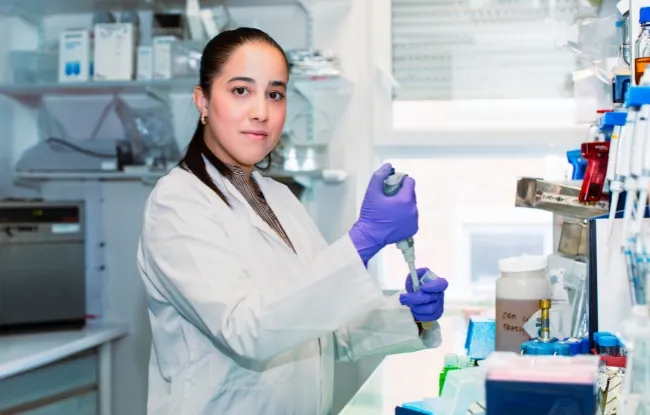
Nicolas Manel, co-founder of LiveRNA.
“Activating innate immunity through cGAS is a mechanism that could potentially be applied to many different tumor types. Our goal is to demonstrate the efficacy of LIV-01 in liver cancer and then expand the technology to additional indications,” adds Sylvain Carlioz, co-founder and future CEO of LiveRNA.
Towards Institut Curie’s 35th start-up
“We are delighted by this new i-Lab distinction, which recognizes an innovative project stemming from the excellence of the research conducted at Institut Curie,” says Dr. Cécile Campagne, director of Institut Curie Technology transfer office and deputy director of Carnot Curie Cancer.
Since 2002, Institut Curie’s start-up creation program has led to the emergence of 34 companies based on technologies developed by its researchers, physicians, and healthcare professionals. Its ambition is to accelerate the market entry of breakthrough innovations with high impact, ultimately improving patient care and quality of life.
“With the forthcoming creation of LiveRNA, we are approaching Institut Curie’s 35th spin-off, a testament to the strategy we have implemented, the quality of our teams, and above all the innovation potential of Institut Curie,” concludes Cécile Campagne.
Spotlight Medical, an Institut Curie spin-off founded in 2024, was also recognized for its innovative clinical decision-support tools leveraging health data and artificial intelligence.
[1] (Inserm U932)
[2] cGAS (cyclic GMP-AMP synthase) is a key enzyme involved in the activation of the innate immune response.
[3] When activated by cGAMP produced through the cGAS pathway, STING (Stimulator of Interferon Genes) triggers, among other effects, the production of type I interferons, molecules that contribute to activating the immune response.