- Home >
- Institut Curie News >
- Dr. Lara Krüger receives an ERC Starting Grant to explore asymmetric cell division and cell fate
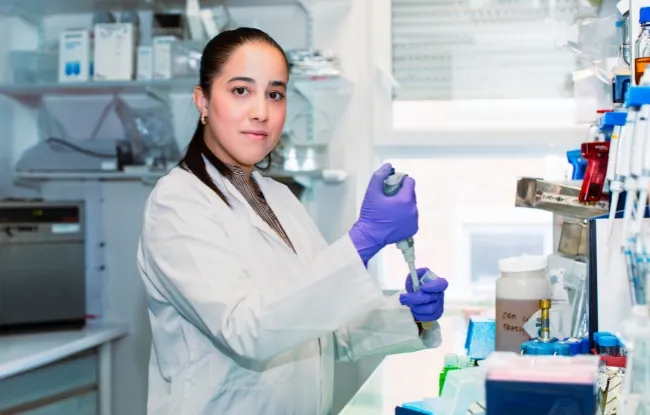
CNRS researcher and research team leader at Institut Curie, Dr. Lara Krüger has received an ERC Starting Grant for her POLYFATE project. With €1.5 million in funding over five years, the project will explore the still poorly understood role of lysosomes, organelles responsible for cellular recycling, in how stem cells give rise to cells with different fates.
Less than two years after joining Institut Curie to establish her own junior research team within Cell Biology and Cancer (CNRS UMR144/Sorbonne Université), Dr. Lara Krüger is taking another major step forward with an ERC Starting Grant, one of Europe’s most competitive funding schemes for researchers in the early stages of building their own team and research program. This support will enable her to delve deeper into a question at the heart of her research: how can a single cell divide to produce two cells with distinct identities?
In mammals, just a small number of stem cells can give rise to hundreds of specialized cell types. This diversity relies in part on asymmetric cell division, in which a mother cell produces two daughter cells that can follow different fates.
Part of the answer may lie with an unexpected player: the lysosome. Long regarded primarily as responsible for recycling cellular components, this organelle also appears to contribute to determining cell fate. During some asymmetric cell divisions, lysosomes are distributed unequally between the two daughter cells, and this difference in inheritance could help shape their future fate.
With the POLYFATE project, Lara Krüger and her team will investigate what controls the unequal distribution of lysosomes between daughter cells during asymmetric cell division. The team will also identify which lysosomal functions play a key role in shaping daughter cell fate, and how unequal lysosome inheritance affects their ability to differentiate.
To dissect these mechanisms, the team will use an experimental system that makes it possible to recreate and control asymmetric cell division in cultured cells. This approach will be applied to embryonic stem cells and adult intestinal stem cells, two models with very different histories. The team will thus be able to follow the process from the mechanisms governing lysosome partitioning to its consequences for gene expression and differentiation.
By connecting these different steps, POLYFATE aims to shed new light on how an asymmetry that emerges during cell division can progressively contribute to the diversity of cell identities within an organism.
1 CNRS researcher and leader of the Asymmetric Cell Division and Cell Fate team (CNRS UMR144/Sorbonne Université) at Institut Curie.