- Home >
- Institut Curie News >
- More than 50 years after the Joliot-Curie, Dr. Irène Buvat receives the George Charles de Hevesy Nuclear Pioneer Award
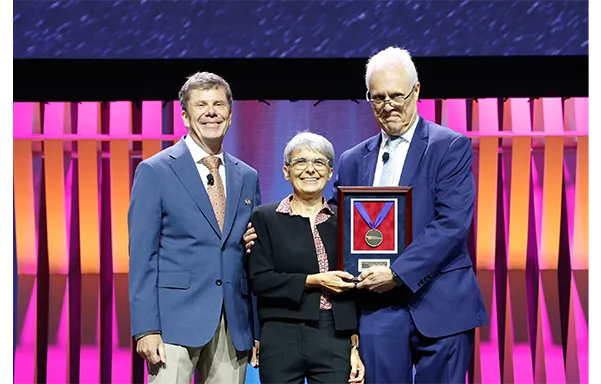
Dr. Irène Buvat, CNRS research director and director of the recently created IRIS unit (CNRS UMR9029 / Inserm U1353 / UVSQ) at Institut Curie, has been named the 2026 laureate of the George Charles de Hevesy Nuclear Pioneer Award. This international distinction, considered one of the most prestigious in nuclear medicine, recognizes her major contributions to quantitative imaging and to the development of approaches that enable more reliable interpretation of medical images.
In 1972, Irène and Frédéric Joliot-Curie received the George Charles de Hevesy Nuclear Pioneer Award, several decades after their discovery of artificial radioactivity. In 2026, the award is presented to Dr. Irène Buvat, CNRS research director and research unit director at Institut Curie.
“This is a tremendous honor. I am very happy to receive this award after having had the opportunity to establish my laboratory at Institut Curie. In an institution so closely linked to the history of radioactivity, this recognition naturally has a very special resonance,” she says.
Presented every year since 1960 by the Society of Nuclear Medicine and Molecular Imaging, the award honors scientists whose work has shaped nuclear medicine. Its prestige reflects both the nature of the contributions it recognizes, often pioneering for the field, and the list of its previous laureates, which includes several Nobel Prize winners and major figures in the discipline. For Dr. Irène Buvat, it recognizes more than 30 years of research focused on a central question: how to transform nuclear medicine images into reliable data to better characterize tumors and assess their evolution.
A physicist by training, Dr. Irène Buvat works at the interface of physics, medical imaging, computer science and oncology. Her research focuses in particular on PET1/CT2 imaging, which makes it possible to quantitatively map the metabolic activity of tissues and certain molecular characteristics of tumors. The aim of her work is to make quantitative image interpretation more reliable: to better understand the biases that affect measurements, correct them and extract precise information from images to characterize tumors, analyze their heterogeneity and monitor their evolution.
Her work has notably led to methods, software and biomarkers widely adopted by academic and industrial communities.
Since January 2026, Dr. Irène Buvat has led the new Imaging, Innovative Radiation Therapy, and System Medicine (IRIS) unit (CNRS UMR9029 / Inserm U1353 / UVSQ / Institut Curie), which brings together four research teams around a shared ambition: to better understand and better treat cancer at the scale of the whole organism, by combining imaging (in vivo and ex vivo), preclinical models and radiotherapy approaches.
[1] Positron Emission Tomography (PET): a medical imaging technique that enables visualisation of tissue metabolic activity or the expression of a molecular target throughout the whole organism.
[2] Computed Tomography (CT): a medical imaging technique that produces detailed anatomical images using X-rays, often combined with PET to precisely localise areas of interest.