- Home >
- Institut Curie News >
- World Cancer Day 2026 : Mayoral elections: Institut Curie warns of regional inequalities in access to cancer care and innovation
More than three out of four French people believe that inequalities exist in cancer care and, above all, perceive persistent and worsening regional disparities in access to care — inequalities that are becoming structural and now represent a genuine public health issue. These findings are revealed, on the eve of World Cancer Day, by the “Curie Cancer 2026” barometer conducted by Institut Curie with Viavoice institute*. With the number of new cancer cases having doubled since 1990 and global incidence expected to increase by 75% to 90% over the next 25 years**, there is an urgent need to rethink and fundamentally transform access to healthcare in order to make innovation available to all patients. As the mayoral election campaign gets underway, and with cancer remaining the leading cause of death in France, Institut Curie is calling for immediate political mobilization to prevent these already deep inequalities from becoming irreversible, and is urging decision-makers to urgently rethink the financing and organization of oncology.
Cancer increasingly present in the daily lives of French people
The “Curie Cancer 2026” barometer reveals a widely shared high level of anxiety: seven out of ten French people say they are worried about cancer. This concern is largely explained by direct or indirect proximity to the disease, which is now the leading cause of death in France—more than eight out of ten French people know someone in their entourage who has been affected. Nearly seven out of ten respondents believe that cancer incidence is increasing compared to previous years. Cancer is no longer perceived solely as a serious disease, but as an omnipresent phenomenon affecting all generations and all regions.
More than three out of four French people say inequalities exist in cancer care
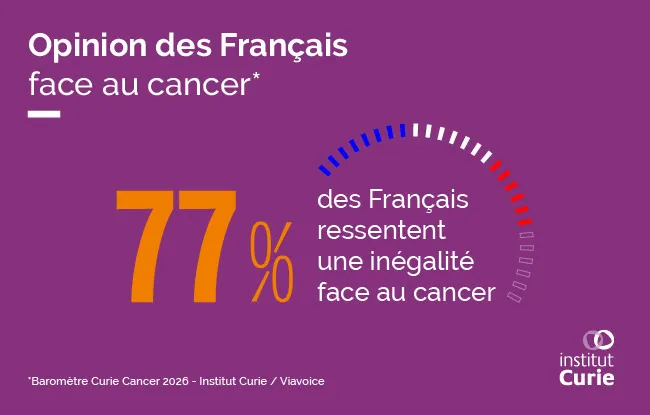
The barometer highlights a growing sense of injustice in relation to the disease: 77% of French people feel that inequalities exist in relation to cancer, a perception that has been increasing since 2019. Place of residence appears to be the primary factor contributing to inequality (38% of respondents), followed by level of information (33%) and income (32%). These three long-standing and deeply rooted dimensions reflect a health divide that particularly affects vulnerable populations, young people, and lower-income groups, who are often less informed and have more limited access to hospital facilities.
“This perception of division highlights a public health emergency that goes far beyond the strictly medical sphere. It calls into question the principle of equal access across the national territory and reaffirms the need to offer everyone—regardless of where they live or their resources—effective access to prevention, screening, support, and therapeutic innovations.” explains Prof. Alain Puisieux, Chairman of the Executive Board of Institut Curie.
Persistent perception of unequal access to care across the country and widespread difficulty in patient care
Access to specialized care remains a major issue for French people, who express a widespread sense of difficulty. Nearly half of respondents (49%) consider access to state-of-the-art medical equipment to be complex, while 55% and 65% respectively report difficulties being admitted to a hospital or obtaining an appointment with a specialist. For most respondents, these essential steps are experienced as a significant administrative and logistical burden.
Regional disparities greatly amplify these challenges. Residents of large urban areas and the Île-de-France region report easier access, while those living in rural or peripheral areas describe a far more constrained experience. This geographic divide, documented for years, now stands out as one of the most structurally significant markers of inequality in healthcare.
« Cette réalité se manifeste très concrètement à l’Institut Curie. Chaque année, le centre hospitalier accueille des patients venant de l’ensemble du territoire français, illustrant la concentration de l’offre de soins spécialisés dans quelques zones. En 2025, un patient pris en charge à l’Institut Curie sur cinq n’est pas francilien. Ce chiffre en augmentation témoigne d’un besoin croissant pour de nombreux Français de se déplacer loin de leur lieu de résidence. Ce phénomène, loin d’être marginal, souligne l’urgence d’une politique volontariste en matière d’accès à la santé et d’organisation territoriale », déclare le Pr Steven Le Gouill, directeur de l’Ensemble hospitalier de l’Institut Curie.
Un enjeu économique et organisationnel majeur pour l’avenir de la cancérologie
Au-delà du constat d’inégalités territoriales, l’évolution des pratiques en cancérologie fait émerger un autre défi : celui du modèle économique et de l’organisation du système de santé. Les innovations diagnostiques et thérapeutiques, comme la médecine adaptative fondées sur la biologie moléculaire, la biopsie liquide ou les outils de médecine personnalisée, nécessitent des investissements lourds dans des équipements spécialisés. Si ces technologies représentent un coût initial important, elles permettent à terme une véritable « épargne thérapeutique », en réduisant le recours à certains traitements lourds, en diminuant les effets secondaires, et en évitant des examens ou séjours hospitaliers coûteux.
“This reality is very evident at Institut Curie. Every year, the hospital welcomes patients from all across France, illustrating the concentration of specialized care in a limited number of areas. In 2025, one in five patients treated at Institut Curie was not from the Île-de-France region. This growing figure reflects the increasing need for many French people to travel far from their place of residence. Far from being marginal, this phenomenon underscores the urgent need for a proactive policy on healthcare access and regional organization” says Prof. Steven Le Gouil, Director of Institut Curie Hospital Group.
Urgent need to rethink healthcare system organization in a key electoral context
These transformations also require a profound rethinking of the healthcare system organization, which remains largely structured around individual procedures (chemotherapy, CT scans, hospitalization). The system must instead be oriented around the patient’s overall care pathway, from early screening to long-term follow-up and relapse monitoring. The challenge is therefore not only technological or economic, but also organizational, territorial, and political.
These changes affect not only infrastructure, but also the training of healthcare workers and their assimilation of new tools and practices.
In a context of growing mistrust in science and increasing misinformation, supporting professionals through these transitions and strengthening confidence in diagnosis are absolute priorities.

The launch of the mayoral election campaign represents a decisive moment to address these challenges. City councils play a fundamental role in access to healthcare through local planning, mobility, support for prevention initiatives, organization of screening programs, and public information. By leveraging these tools, local governments can make a tangible difference in reducing the inequalities experienced by citizens.
“This is why Institut Curie is calling on future mayoral teams and public authorities to place the fight against health inequalities—particularly those related to cancer—at the heart of their commitments. Cancer can no longer be addressed solely as a medical issue; it must be recognized as a social, territorial, and political challenge, to which local authorities can provide concrete and essential responses,” concludes Prof. Alain Puisieux.
* Survey conducted by ViaVoice with Institut Curie between January 2 and 5, 2026, among a representative sample of 1,000 people aged 18 and over.
** Global cancer burden: progress, projections, and challenges – The Lancet, 11 octobre 2025
A public health challenge:
National implementation of adaptive and personalized medicine
Driven by excellence in basic, translational, and clinical research, Institut Curie is at the forefront of adaptive and personalized medicine—a true paradigm shift in oncology aimed at tailoring patient care as closely as possible to the reality of each individual’s disease. Institut Curie relies on state-of-the-art infrastructure and teams whose unique expertise enables them to offer every patient the most appropriate strategy at the most opportune moment.
By developing these innovations—from diagnosis to personalized follow-up and increasingly targeted treatments—Institut Curie is making concrete progress toward its ambition: contributing to a world without incurable cancers.
Find out more: Tumor dynamics at the heart of adaptive and personalized medicine at Institut Curie