- Home >
- Institut Curie News >
- Institut Curie and the CNRS renew their framework agreement to foster excellent, interdisciplinary and open research
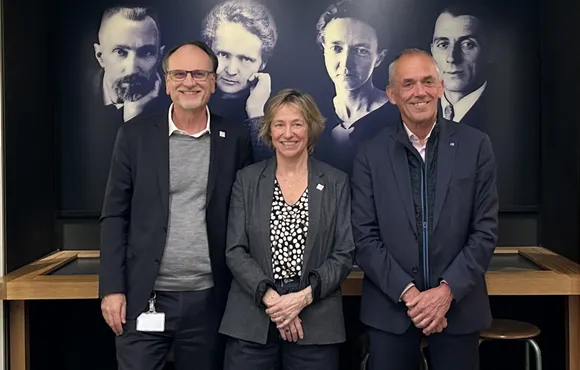
Institut Curie and the CNRS announce the renewal of their framework agreement for a four-year period. This strategic agreement defines the terms of collaboration within the joint research and service units based at Institut Curie, defining the principles governing organization, steering, and valorization of scientific results. Its objective is to formalize a shared commitment to strengthening excellent, interdisciplinary and open research.
The framework agreement between Institut Curie and the CNRS has just been renewed for a four-year term. This new agreement governs the modalities of collaboration within the joint research and service units based at Institut Curie. The framework1 formalizes and secures the organization, governance and valorization of the work conducted jointly by Institut Curie and the CNRS, in line with agreements concluded or currently being finalized with the other supervisory bodies of the units (notably Inserm, universities and Mines Paris-PSL).
Through this agreement, Institut Curie and the CNRS reaffirm their commitment to developing joint collaborations and research programs, with the aim of promoting bold, cross-cutting fundamental research and thereby accelerating innovation for the benefit of patients.
“Fundamental research remains, even today, the primary source of major medical breakthroughs, which in my view clearly illustrates the importance of the link between Institut Curie and the CNRS,” explains Prof. Alain Puisieux, Chairman of the Executive Board of Institut Curie.
“I would like to commend the strength and vitality of this exemplary and ambitious partnership between CNRS and Institut Curie. Together, our teams combine their expertise to conduct fundamental research at the highest international level. Thanks to their commitment, we are enhancing our understanding of diseases while transforming these advances into concrete innovations that serve the health of citizens,” adds Prof. Antoine Petit, Chairman and CEO of the CNRS.
“The renewal of this agreement with CNRS reflects a shared ambition: to develop interdisciplinary, collaborative and ethical research that is bold and disruptive, in the service of knowledge, healthcare and society,” continues Dr. Claire Rougeulle, Director of the Research Center of Institut Curie and CNRS Research Director.
A privileged scientific alliance behind major successes
For many years, the close collaboration between Institut Curie and the CNRS has contributed to the emergence of advances with strong scientific and medical impact. At Institut Curie, several CNRS researchers have received prestigious distinctions. This is the case of Dr. Céline Vallot, CNRS Research Director and group leader, recently elected a member of the French Academy of Technologies and recipient of the 2025 Maylis Prize from the French Foundation for Medical Research (FRM) for her work on mechanisms of resistance to breast cancer treatments. Dr. Julien Robert-Paganin, CNRS Research Fellow, was awarded the 2025 CNRS Bronze Medal for his work in structural biology and biophysics with promising therapeutic perspectives.
The excellence of this research is also regularly recognized at the European level through highly competitive funding schemes. By way of example, three projects involving CNRS researchers at Institut Curie were awarded ERC Synergy Grants in 2025, flagship funding instruments that support the most ambitious scientific projects.
Driven by a dynamic aimed at strengthening the continuum between fundamental research and innovation, this long-standing alliance has also led to the creation of successful start-ups developing cutting-edge technologies. Among them is Abivax, whose molecule, stemming from research conducted at Institut Curie by Dr. Florence Mahuteau-Betzer, CNRS Research Director, advanced through clinical phases in 2025, offering real hope to millions of patients suffering from ulcerative colitis. Cereus Biosciences, co-founded by Dr. Antonin Morillon, CNRS Research Director and Unit Director at Institut Curie, began operations in 2025 and positions itself as a pioneering company in the exploration of the “dark genome” to develop cancer vaccines.
Building on the scientific, medical and technological successes resulting from their long-standing collaboration, Institut Curie and the CNRS are committed to going even further and accelerating research in the service of discoveries that will shape the medicine of tomorrow.
[1] This agreement is based on a governance structure comprising three bodies: a monitoring and consultation committee (institutional dialogue, annual review, resources, health/safety/radiation protection), an operational contracts committee (monitoring of contractual activity, sticking points, specific mechanisms including ERC projects) and a promotion committee (harmonization of strategies for protecting and exploiting results).