- Home >
- Institut Curie News >
- X chromosome inactivation, a mechanism that protects female cells during early embryonic development
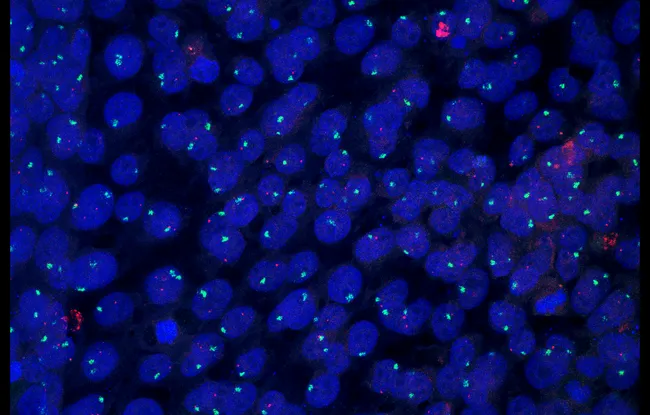
Around the time a female embryo implants in the uterus, its cells normally switch off one of their two X chromosomes. How this process unfolds and whether it is essential for further development has remained unclear in humans. Researchers from KU Leuven and Institute Curie have now shown, using human stem cell models, that the RNA molecule XIST controls X chromosome inactivation and that placental cells do not survive properly when this inactivation fails. The study was published on October 22 in Nature Communications.
Women typically have two X chromosomes, while men have one. During early development, one of the two X chromosomes is largely switched off in female cells, meaning that most of the genes it carries are no longer expressed. However, in humans, what happens during this process and what role it plays in the development of cells that later contribute to the placenta and other extraembryonic tissues have remained unclear.
Mimicking the earliest stages of development
Using a model in which human stem cells grown in the lab mimic the tissue that surrounds an embryo during the first days of development, the researchers first showed that one X chromosome was largely switched off as these cells took on their specific roles.
“We found that the inactivation of one X chromosome coincides with the formation of cells that will later form the placenta and other tissues that support the embryo.”, explains Dr Amitesh Panda1 (KU Leuven).
XIST is essential for development
XIST is an RNA molecule that binds to one X chromosome and is known to cause its inactivation in mice. While its role is well established in other mammals, its function during the early stages of human development remained to be demonstrated.
When the researchers switched off XIST, both X chromosomes remained active, and cells destined to contribute to placental and other extraembryonic tissues failed to survive in the model system. XIST-mediated X chromosome inactivation may be required for the development and maintenance of human extraembryonic cell lineages.
“Our results show that XIST is not only associated with X-chromosome inactivation but may also be important for the further development of female placental cells,” says Pr. Vincent Pasque (KU Leuven).
An atypical pattern of X chromosome regulation
Surprisingly, the inactive X chromosome did not display all the molecular features typically associated with X chromosome inactivation in other mammals. Despite the absence or low levels of several markers usually associated with the inactive X chromosome, many X-linked genes remained silent. These findings suggest that X chromosome inactivation may be established or maintained differently during early human development.
“This work highlights why we need human models. Not all mechanisms known from other mammals work in exactly the same way in humans.” explains Dr. Jean-François Ouimette of Institut Curie.
A new way to study a difficult stage of development
“Early human development is a complex process in which things can go wrong at many different stages, sometimes preventing embryos from surviving. For people who want to have children, it is not always easy to accept that science still does not have answers to all fertility problems. Our study is a first step towards finding solutions, using a new stem cell model that makes it possible to investigate a stage of development that is otherwise very difficult to study,” concludes Dr. Claire Rougeulle, Director of Institut Curie’s Research Center.
The researchers stress that this model is a simplified model of early development and might not fully recapitulate what happens in an actual human embryo. Further research is therefore needed to confirm these findings and better understand the role of the X chromosome in embryo implantation and early pregnancy.
[1] Postdoctoral researcher at KU Leven and at the Max Planck Institute for Molecular Genetics.