- Home >
- Institut Curie News >
- Three Institut Curie researchers honored at the French Academy of Sciences awards ceremony
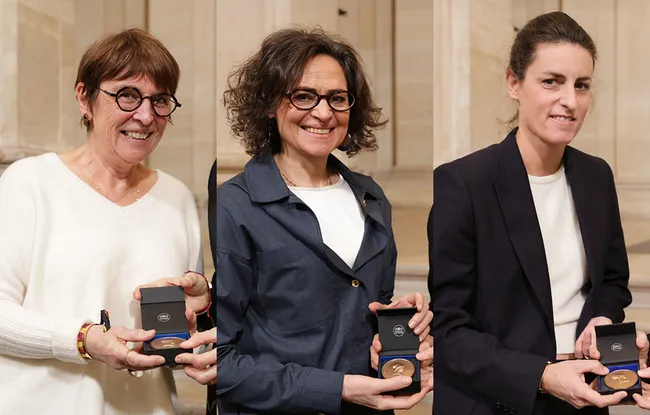
Following an initial awards ceremony on October 27, 2026, the French Academy of Sciences honored three more researchers from Institut Curie on November 24 under the dome of the Institut de France: Dr. Patricia Bassereau for her work on the physical properties of cell membranes, Dr. Eliane Piaggio for her advances in immunotherapy, and Dr. Céline Vallot for her research into the epigenetic mechanisms involved in cancer.
Dr. Patricia Bassereau: Fondation de France Joffard Brothers Prize in Physics
Far from being simple barriers, cell membranes are dynamic structures that constantly deform and reorganize. Their physical properties play an essential role in how cells function and move.
At the intersection of physics and biology, Dr. Patricia Bassereau, CNRS research director and head of the Membranes and Cellular Functions (CNRS UMR168 / Sorbonne Université) at Institut Curie, explores these mechanisms using biomimetic systems that reproduce some of the properties of natural membranes.
By combining these models with microscopy and mechanical measurements, she seeks to understand how cells take up molecules, adhere, migrate, and sense forces exerted by their environment. Her work thus sheds light on the role of physics in the fundamental mechanisms of life.
Dr. Eliane Piaggio: Irène Joliot-Curie Prize, “Women, Research and Business” category
The immune system relies on regulatory mechanisms that are essential to prevent it from attacking the body’s own tissues. However, tumors can also exploit these protective mechanisms to evade our immune defenses.
Dr. Eliane Piaggio, Inserm research director and head of the Translational Immunotherapy (Inserm U932) at Institut Curie, focuses in particular on regulatory T cells, which act as brakes on the immune system.
Her discoveries have opened up two therapeutic avenues: stimulating these cells with low-dose interleukin-21 to limit excessive immune responses in autoimmune diseases, or, conversely, targeting their activity within tumors to strengthen immune defenses against cancer.
This second approach notably led to the founding of Egle Therapeutics in 2020, a company she co-founded to develop drugs targeting regulatory T cells, two of which are now in clinical development.
Dr. Céline Vallot: Human Biology and Medical Sciences Section Medal
How do cancer cells manage to resist treatment without altering their DNA? This is one of the key questions driving the research of Dr. Céline Vallot, CNRS research director and head of the Dynamics of Epigenetic Plasticity in Cancer (CNRS UMR3244 / Translational Research Department / Sorbonne Université) at Institut Curie.
She studies cellular plasticity, the ability of cells to change their identity and behavior, particularly through epigenetic mechanisms that alter gene activity without changing their DNA.
By developing technologies that enable cells to be analyzed individually (single-cell technologies), her team seeks to understand the role of these changes in breast cancer progression and resistance to treatment, with the aim of identifying new strategies to overcome them.
© Photography - Académie des sciences/Mathieu Baumer
[1] Interleukin-2 (IL-2): a naturally occurring protein in the body that enables immune cells to communicate with one another and helps regulate their activity.