- Home >
- Institut Curie News >
- ATOMIC: Prof. Gilles Créhange’s research team explores new approaches to personalized radiation therapy
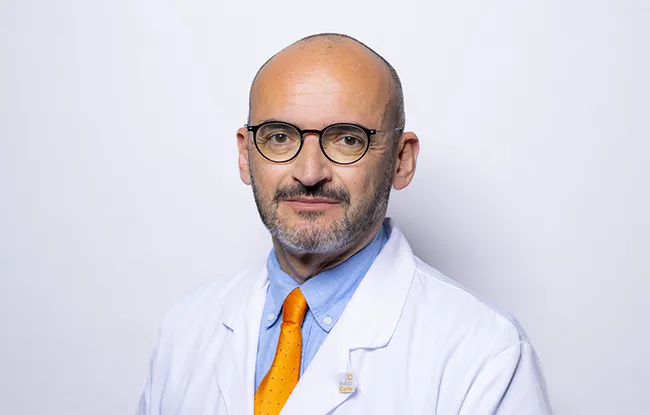
Since early 2026, Prof. Gilles Créhange, Head of the Department of Radiation Oncology at Institut Curie, has led the Advanced Therapy in Radiation Oncology and Molecular Imaging Characterisation (ATOMIC) research team within the IRIS unit. Bringing together physicians, physicists, and researchers, the team aims to better understand how tumors and healthy tissues respond to radiation and to explore new irradiation techniques to further tailor radiation therapy to each patient.
While working as a radiation oncologist in Dijon, Prof. Gilles Créhange became interested in what imaging could reveal about a tumor’s response to radiation. In 2011, he explored this question in his PhD thesis, investigating how proton magnetic resonance spectroscopy could help assess the response of prostate cancer to radiation.
After joining Institut Curie in 2018, he continued his research alongside his clinical practice as part of Dr. Irène Buvat's team. In particular, he explored how PET imaging and radiomics could help predict the response to radiation therapy and inform decisions about reirradiating a previously treated area.
In early 2026, this work found a new framework with the creation of the Imaging, Innovative Radiation Therapy and System Medicine (IRIS) (CNRS UMR9029 / Inserm U1353 / UVSQ) led by Irène Buvat. Gilles Créhange became leader of the Advanced Therapy in Radiation Oncology and Molecular Imaging Characterisation (ATOMIC) team, which brings together expertise in imaging, radiobiology, and medical physics across the Orsay, Paris, and Saint-Cloud sites.
“At the hospital, there are questions we wish we could answer better. With ATOMIC, we can look at them from different perspectives, drawing on everyone’s experience. That’s what motivates me: starting with a challenge encountered in patient care and working together to find a way forward,” says Gilles Créhange.
Better predicting response, better protecting healthy tissues
The team’s first goal is to better understand the sensitivity of tumors and healthy tissues to radiation. By combining information extracted from medical images with biological data, including genomic data, the team hopes to identify indicators that can predict how tumors and healthy tissues will respond.
Imaging could also help protect healthy tissues: by providing information about the function of organs exposed to radiation, it could ultimately allow their sensitivity to be better taken into account when planning radiation therapy.
“We lack biomarkers, and we would like to use imaging to fine-tune and better personalize the dose according to each individual and their radiosensitivity,” explains Gilles Créhange.
ATOMIC also explores new irradiation techniques, including minibeams and FLASH radiation therapy, which is based on an effect discovered at Institut Curie. FLASH involves delivering radiation at very high dose rates in less than a second, with the aim of better preserving healthy tissues while maintaining effectiveness against the tumor. This is currently the team’s most advanced area of research, notably through the FRATHEA project, coordinated by Gilles Créhange, which combines the FLASH effect with very high-energy electrons to reach deep-seated tumors.
Led by Institut Curie in collaboration with the CEA, FRATHEA has received €37 million in funding over four years from France 2030 and the Île-de-France Region: €35 million through the Health Innovation 2030 plan, the health component of France 2030, and €2 million from the Region through its “Grands lieux d’innovation” (GLI) program. Thales has been selected to build, assemble, and install the FLASH-VHEE irradiator at the Orsay Proton Therapy Center by 2028. The goal is to establish a one-of-a-kind platform by 2029 to demonstrate the effectiveness and safety of FLASH-VHEE radiation therapy and launch the first clinical trials in patients with cancers associated with a particularly poor prognosis.