- Home >
- Institut Curie News >
- Ovarian cancer: tumour cells ‘configured’ to resist treatment
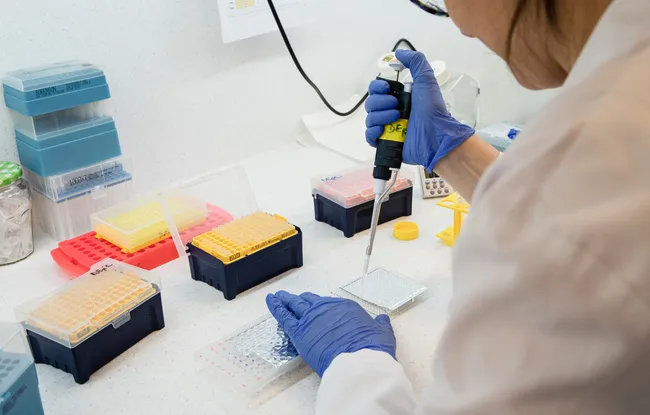
- In one aggressive form of ovarian cancer, the initial status of the tumour cells may contribute to the explanation for why they resist treatment.
- Scientists have identified cell states associated with chemoresistance and shown how some cells are epigenetically ‘configured’ to resist treatment.
- These results open up potential for new ways of identifying and diagnosing patients that may be susceptible to poorer chemotherapy responses.
Could epigenetic tumour cell state help doctors to anticipate chemotherapy response? This is what scientists from the CNRS, the Institut Curie, the Sorbonne Université and start-up One Biosciences suggest in a study published in Cancer Discovery on 19 October 2026. By following the evolution of tumour cell composition cell by cell in patients with high-grade serous ovarian cancer before and after treatment, the scientists have identified cell states associated with chemoresistance and discovered that some tumour cells are ‘configured’ to resist before the treatment ever starts. These results open up paths for the development of tools that can identify patients who may respond less well to chemotherapy at the time of diagnosis.
Learn more about ovarian cancers
High-grade serous ovarian cancer is aggressive form of ovarian cancer, characterized in particular by high diversity in the cells that compose a given tumour. This intra-tumour heterogeneity is a major challenge in understanding why some tumours respond to treatments and other resist. Additionally, this diversity is not limited to genetic differences: tumour cells that have similar genetic profiles may have different functions, depending on the genes that they express and their epigenetic state1.
To characterize this diversity, a research team2 from the CNRS, the Institut Curie and the Sorbonne Université used a sequencing approach at the scale of individual nuclei to individually analyse tumour cells and monitor how their molecular characteristics changed. This study was run in collaboration with start-up One Biosciences3, a spin-off from the Institut Curie co-founded by 2022 CNRS Innovation Medal laureate4 Céline Vallot, who is leading this study.
An innovative way to monitor how the tumour changes throughout treatment
In the first instance, 150 tumour biopsies from biobanks went through this analysis. Then the method was used on 16 patients, before and after treatment, over a period of 3 to 6 months, as part of longitudinal study SCANDARE5.
The scientists observed patterns in how cells changed according to treatment response. In patients whose tumour responded to treatment, the scientists saw a reduction in tumour cell division, or even it stopping completely, and likewise a reduction in cells that activate interferon-response pathways. Those are a set of molecules that play an important role in an organism’s immune response.
On the contrary, in patients that did not respond to treatment, some tumour cell populations increased and activated pathways associated with resistance, in particular those related to TNFα, a molecule involved in the body’s inflammation responses, and EMT, a process for changing cell properties, in particular regarding adherence and mobility.The study also showed that a higher proportion of cells dividing at the time of diagnosis is associated with a better treatment response and a longer overall survival rate.
Cells already ‘configured’ to resist before treatment
This begs the question: do these cell states associated with resistance appear under the effect of the treatment, or did they exist beforehand? Thanks to epigenomic analyses, the scientists have shown that cells associated with chemoresistance are already ‘pre-configured’ epigenetically to resist, even before the start of treatment. However, this idea of epigenetic predisposition does not mean that the cells are already resistant, nor that they are necessarily destined to become resistant. What it means is that their initial state could facilitate the activation of programs associated with resistance when they are confronted with treatment.
These results show that DNA mutations alone do not explain treatment-resistance and they underline the importance of studying tumour cells before they are exposed to chemotherapy.
Promising perspectives for improving patient care
These results must be confirmed in larger cohorts before this approach can be used clinically. They do form a first step though towards the development of diagnostic tools that will allow better mapping of tumour state to anticipate how they will change during treatment. Beyond ovarian cancer, this approach is already used by One Biosciences in several cancer types, in collaboration with hospitals in Europe and the USA. They aim to better understand the mechanisms that determine the response or resistance to treatments, and, eventually, may contribute to more precisely directing the choice of therapy for each patient.
The scientists have already identified candidate transcription factors and proteins involved in activating these resistance pathways. Understanding their roles more closely through further research could contribute in the future to identifying new therapeutic targets and to the development of medicines that can block some mechanisms that encourage resistance. This understanding could also contribute to exploring new approaches that target the limiting the capacity of tumour cells to change state during treatment.
[1]Epigenetic denotes all the mechanisms that modulate gene activity without changing their DNA sequence.
[2]Laboratories: Dynamics of Genetic Information: fundamental bases and cancer — DIG-CANCER (CNRS/Institut Curie/Sorbonne Université) and Physics of Cells and Cancer (CNRS/Institut Curie/Sorbonne Université) and the Transitional Research and Drug Development and Innovation departments at the Institut Curie’s Diagnostic and Theranostic Medicine Division.
[3]Created from the pioneering work of Céline Vallot, CNRS Researcher in the Dynamics of Genetic Information: fundamental bases and cancer laboratory (CNRS/Institut Curie/Sorbonne Université) and research team lead at the Institut Curie, the start-up One Biosciences specialises in precision oncology and single-cell analysis. The company, a spin-off from the Institut Curie, uses the power of single-cell sequencing combined with artificial intelligence to adapt treatments for each patient. https://onebiosciences.fr/
[4]For more information: 2022 Innovation Medal laureates | CNRS
[5]Study sponsored by the Institut Curie and targeting tumour samples in several types of cancers.
Source
Bibliography :
H3K4me1-mediated epigenomic priming of chemoresistant tumor states in ovarian cancer. Y. Landais et al. Cancer Discovery, 19 October 2026.