- Home >
- Institut Curie News >
- Breast cancers: tumors-on-a-chip, a new ultra-personalized technology to guide therapeutic decisions
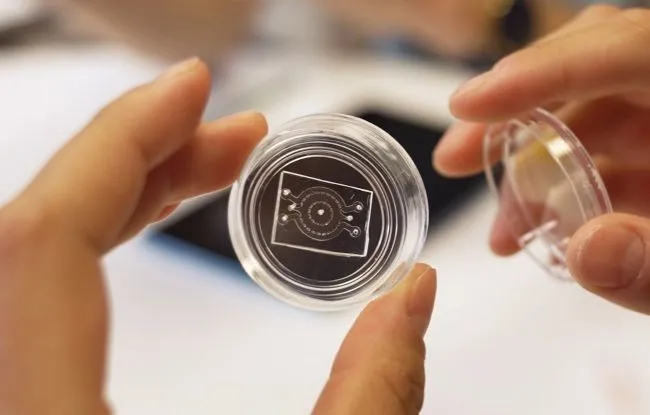
A new method for selecting the most suitable treatments for patients with metastatic breast cancer, based on "tumor-on-chip" technology, has been validated by several teams from Institut Curie and the CNRS. Published in Cell Reports Medicine on 28 August 2026, their "proof of concept" results lay the foundations for a clinical trial led by Institut Curie which should start in 2027, paving the way for a shift in clinical practice regarding patient care.
With more than 61,000 new cases in France in 2023, breast cancer is the most prevalent cancer and the leading cause of cancer deaths among women1. It is a heterogeneous disease, which can progress rapidly, and at the metastatic stage, there are very few biomarkers to guide the choice of treatment. It is therefore necessary today to develop tools to guide caregivers towards personalized treatments adapted to each patient and within timelines compatible with clinical practice.
Tumor-on-chip for rapid modeling
Tumor organoids2, patient-derived xenografts3, tumor-on-chip models, etc.: various 3D tumor modeling methods are currently being explored, particularly in the laboratories of Institut Curie. These various technologies aim to carry out functional tests to evaluate the effectiveness of treatments in order to predict the response of patients to different therapeutic molecules.
"Some of these models have a major limitation: the time required to generate them, incompatibility with rapid use in the clinic, as may be necessary in certain situations. Thanks to our tumor-on-chip models, we are providing a solution," explains Dr. Stéphanie Descroix, CNRS Research Director, Deputy Director of the Joint Unit for Physics of Cells and Cancer (Institut Curie / CNRS / Sorbonne University) and Director of the Pierre Gilles de Gennes Institute (IPPG-PSL) and Co-Director of the PEPR MED-OOC.
The researchers built 3D models of tumors derived from patients' cells, replicating the diversity of the tumor ecosystem, as well as the physicochemical parameters of the tissues. These models are miniature systems manufactured thanks to microfluidics, maintained in controlled environments (see photos), called tumor-on-chip.
"We are not reproducing full-fledged organs, but a three-dimensional modeling of the tumor, to understand how it functions and evolves. And in particular, how it responds to, or, on the contrary, resists, different treatments," specifies Stéphanie Descroix.
Towards a clinical trial in 2027
The team compared the treatment sensitivity and resistance results (chemotherapy, antibody-drug conjugates) generated by the tumor-on-chip models with those obtained using the in vivo patient-derived xenograft method. In 88% and 91% of cases respectively, the results on chips correspond to those obtained in vivo, and were obtained in just 4 days. "We therefore show that in 4 days, a period compatible with clinical practice, it is possible to discriminate the response and resistance profiles of patients," continues Stéphanie Descroix.
This proof-of-concept study thus validates an important stage in the feasibility of this method. Next step: the validation of these results in a clinical trial, essential before integrating this technology into clinical practice. This one is scheduled for the second semester of 2027 and will be coordinated by Dr. Stéphanie Descroix and Dr. Luc Cabel, medical oncologist at Institut Curie and co-senior author of this study.
Tools for adaptive medicine
"This multidisciplinary work, bringing together several teams at Institut Curie, unites researchers and clinicians alike; it illustrates how these teams collaborate to realize the vision of adaptive medicine by developing personalized technologies that can be rapidly deployed by healthcare professionals. "In the longer term, this tumor-on-chip technology, along with other functional models, could be used in research to test the efficacy of new molecules, helping to further expand the existing therapeutic arsenal," concludes Stéphanie Descroix.
Source
Tumor-on-Chip as a Personalised Platform for Rapid Drug-Testing in Breast Cancer
Clara Helal, Léa Pinon, Juliette Jin, Niccolo Schintu, Ana Vazquez, Léna Domalain, Martin Nurmik, Gianni Antonelli, Ségolène Ladaigue, Maxime Simon, Elodie Montaudon, Laura Sourd, Heloise Derrien, Gérard Zalcman, Angela Bellini, Andreia Goncalves, Anne Vincent-Salomon, Toulsie Ramtohul, Elisabetta Marangoni, Maria Carla Parrini, Luc Cabel, and Stéphanie Descroix –
28 August, 2026 – DOI : 10.1016/j.xcrm.2026.103011
The work for this publication was carried out with the support of three initiatives:
- The PRPE (Priority Research Programs and Equipment) MED-OOC, supported by the CNRS, Inserm and the CEA, with PSL University also being a partner in the project. The objective is to develop miniaturized devices allowing to reproduce in vitro different characteristics of living organs in physiological or pathological condition. https://www.pepr-medooc.fr/
- The Women's Cancer Institute and its key initiative PADEMO: founded in 2023 by Institut Curie, PSL University and Inserm, the IHU Women's Cancer Institute aims to accelerate all projects related to breast and gynecological cancers, as well as to improve the prevention of women's cancers, cure an increasing number of patients with female cancers, and limit relapses and the impact on quality of life.
- The ARTURO project : this project benefits from funding from the European Commission as part of the Horizon Europe program, Cancer 2023 Mission, convention # 101136464, to explore the role of the intra-tumor microbiota - all the bacteria present in tumors - in the therapeutic responses of cancers thanks to an innovative 3D tumor-on-chip model. https://www.arturoproject.eu
This research was also supported by VIASANTE Mutuelle.
"However, the views and opinions expressed in this release are those of the author(s) only and do not necessarily reflect those of the European Union or the European Health and Digital Executive Agency (HaDEA). Neither the European Union nor the financing authority can be held responsible for this."
1 Source : Institut National du Cancer
2 These three-dimensional structures grown in the laboratory from tumor cells reproduce certain characteristics of the patient's cancer. Learn more
3 These are modeling methods that are based on the transplantation of human tissues into mice.