- Home >
- Institut Curie News >
- Resistant female cancers: Dr. Raphael Ceccaldi's promising project rewarded
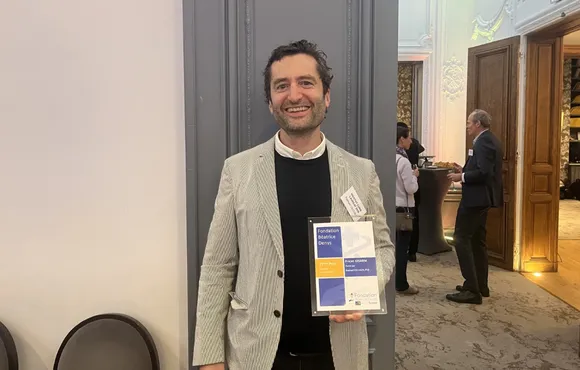
Congratulations to Dr. Raphael Ceccaldi, head of a research team at Institut Curie, whose project has just been awarded a prize by the Beatrice Denys Foundation for Therapeutic Innovation, placed under the aegis of the Foundation for Medical Research. He and his team have identified a key enzyme in the DNA repair mechanism. This promising discovery has led to the creation of Unguard Therapeutics, a spin-off from Institut Curie. The ultimate goal is to develop new therapeutic strategies for breast and ovarian cancers, which are particularly aggressive and resistant to conventional treatments.
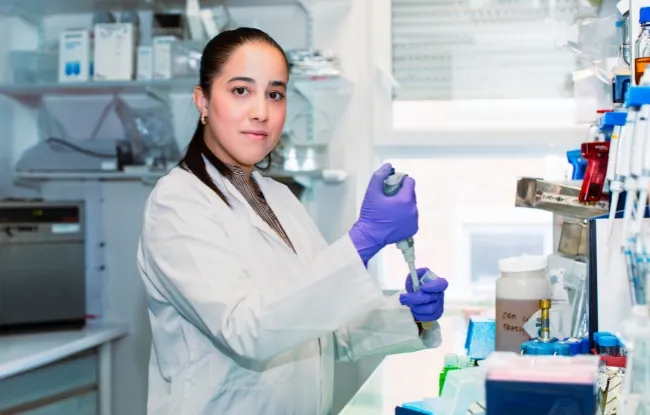
Dr. Raphael Ceccaldi, head of the Alternative DNA repair mechanisms in human cancers team at Institut Curie.
In 2022, the World Health Organization estimated that there were almost 2.3 million new cases of breast cancer and ovarian cancer in the world[1]. These aggressive cancers, which often carry a poor prognosis, remain difficult to treat due to their high genomic instability, which limits therapeutic options. In about half of all cases, these cancer cells have DNA repair defects, primarily linked to BRCA gene mutations. Unable to efficiently repair their DNA, the cells rely on alternative repair pathways to survive.
Dr. Raphaël Ceccaldi, recipient of the Beatrice Denys Foundation for Therapeutic Innovation[2] award, has been granted €100,000 for his DISARM project, which is dedicated to targeting this DNA repair defect. Placed under the aegis of the Foundation for Medical Research and supported by Turenne Capital, this program supports scientific projects of excellence intended to provide a therapeutic benefit to patients, health professionals, and care systems in the fields of cardiovascular, oncology, and neurology.
The DISARM project is fully in line with the objectives of the Institute of Women’s Cancers, supported by Institut Curie, PSL University and Inserm, whose ambition is to develop innovative, targeted, and personalized therapeutic approaches to cure more and more patients with female cancers.
Unguard Therapeutics: new therapeutic strategies against drug-resistant cancers
Dr. Ceccaldi and his team have shown that the presence of uracil in the genome strongly alters the survival of tumor cells in a subtype of breast and ovarian cancers.
"Tumor cells with BRCA1/2 mutations already have impaired DNA repair capacity. Forcing the incorporation of uracil into the genome makes it possible to selectively eliminate cancer cells, and in particular those resistant to current treatments, while preserving healthy cells," explains the researcher.
This strategy, while especially promising for breast and ovarian cancers resistant to conventional treatments (such as PARP inhibitors or chemotherapy), may also prove effective against other cancer types with similar DNA repair abnormalities. This unique approach, supported by Institut Curie’s Technology transfer office, led to the creation of Unguard Therapeutics, an Institut Curie spin-off co-founded by Dr Raphaël Ceccaldi.
The obtained funding will make it possible to validate the effectiveness of molecules of interest developed by the laboratory in the preclinical phase in order to identify the most promising candidates. These molecules will then be transferred to the Unguard Therapeutics to accelerate their progression to clinical trials and bring this innovation to patients with treatment-resistant cancers.
[1]https://www.who.int/news-room/fact-sheets/detail/breast-cancer
[2]Created in 2006 and managed entirely by the Turenne Health teams, the Beatrice Denys Foundation aims to financially and voluntarily support initiatives resulting from academic medical research, composed around one or two researchers, in order to create a company.