- Home >
- Institut Curie News >
- Dr. Céline Vallot receives the 2026 Fondation de France / Jean Valade Young Researcher Award
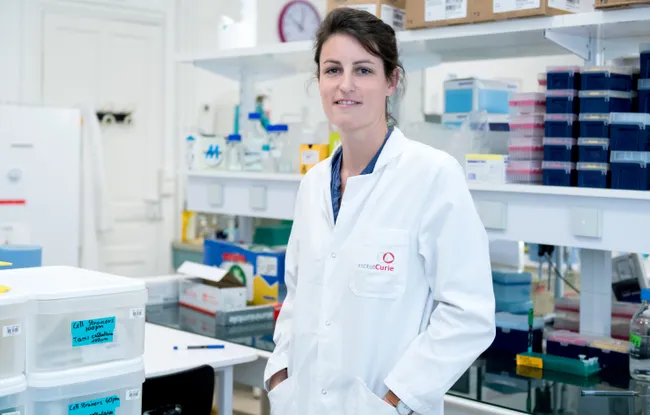
On March 19, 2026, Dr. Céline Vallot, CNRS research director and research team leader at Institut Curie, was awarded the 2026 Fondation de France / Jean Valade Young Researcher Award. This distinction highlights her team’s work on triple negative breast cancer, a particularly aggressive form of the disease, and their efforts to understand how tumor cells evade treatment.
In 2026, Fondation de France and Fondation Jean Valade joined forces to honor two outstanding scientists whose work is driving major advances in medical research. The initiative includes a senior award and a young researcher award, recognizing scientists whose research shows strong potential for clinical application. On this occasion, Dr. Céline Vallot received the Young Researcher Award, endowed with €50,000.
A CNRS research director at Institut Curie, Dr. Céline Vallot leads the Dynamics of Epigenetic Plasticity in Cancer team (CNRS UMR3244 / Translational Research Department / Sorbonne University)[1]. Her research focuses on triple negative breast cancer, which accounts for around 15% of cases in France and is characterized by high aggressiveness and a significant risk of relapse.
To better understand this aggressiveness, her team investigates the epigenetic mechanisms that enable tumor cells to adapt to and escape treatments. Using single cell profiling, multi omics analyses, and modeling approaches, her team reconstructs cellular trajectories and identifies key windows of therapeutic vulnerability.
These approaches recently led to the identification of a key mechanism of transient treatment tolerance in triple negative breast cancer. Published in November 2025 in the journal Cancer Research, these findings reveal a shared cellular program underlying relapse, observed across patients regardless of the treatments received.
Better characterizing these dynamics opens new perspectives for patient management. By refining the identification of at risk profiles, particularly in women carrying specific mutations, this work could help anticipate disease progression and guide more precise therapeutic strategies.
[1] Dr. Céline Vallot is also Scientific Director of the CurieCoreTech Custom Single Cell Omics platform and coordinator of the Single cell initiative.