- Home >
- Institut Curie News >
- 2026 International Childhood Cancer Day : Adapting to Provide Better Care: A New Era for Pediatric Cancers at Institut Curie
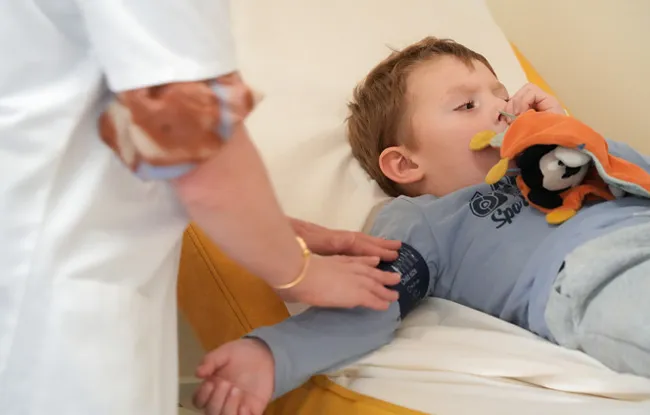
Teams at Institut Curie are guided by a single ambition: to save children’s lives while giving them the chance to grow up as normally as possible. Rare but often aggressive, pediatric cancers require a tailored, humane, and gentle approach. At Institut Curie, researchers and physicians work hand in hand to personalize each treatment for every child and their tumor—from the earliest diagnosis to long-term monitoring of side effects. Circulating biomarkers, immunotherapies, and research into cellular plasticity are opening new avenues of hope and ushering in a new era of care.
“For each of our young patients, initiating the most appropriate treatment, assessing its effectiveness as early as possible, and adjusting the therapeutic strategy when needed are at the very heart of adaptive medicine as practiced at Institut Curie,” said Dr. Olivier Delattre, Director of Institut Curie SIREDO Center (Care, Innovation & Research in Childhood, Adolescent, & Young Adult Oncology). “It is essential to monitor and understand the progression of pediatric cancers in order to treat them more effectively. Closely tracking disease progression allows us to act sooner, maximize treatment effectiveness, and reduce long-term side effects.”
The SIREDO team
- 60 caregivers
- 70 scientists
- 1 dedicated research unit with 6 teams
- 700 young patients treated annually, including 350 new cases.
- 36 clinical studies in 2024 involving 147 children, adolescents, or young adults
Each year in France, approximately 2, 500 children are diagnosed with cancer, most commonly leukemia, brain tumors, and solid tumors. Nearly 700 of these patients receive care annually at the SIREDO Center at Institut Curie—the only center of its kind in France. By bringing together research, care, and teaching in one location, the center embodies the research-care continuum and the deployment of adaptive medicine: continuously refining diagnosis, treatment, and follow-up through laboratory innovations such as immunotherapy and liquid biopsy to deliver the most personalized care possible.
“Using cutting-edge technologies, teams at Institut Curie are deciphering the mechanisms of oncogenesis, tumor plasticity, immune microenvironments, and early biomarkers specific to pediatric cancers such as medulloblastoma, neuroblastoma, rhabdoid tumors, and Ewing sarcoma. Our goal is to better understand the biology driving these cancers so we can develop more adaptive and personalized strategies for children,” said Dr. Olivier Ayrault, CNRS Research Director and Director of the Children’s Oncology Research Unit (Institut Curie, Inserm).
Recently, Dr. Ayrault’s team identified a new vulnerability in particularly aggressive forms of medulloblastoma, one of the most common malignant brain tumors in children. 1
The Promise of Pediatric Immunotherapy
Immunotherapy is opening new prospects in the care of pediatric cancers, particularly Ewing sarcoma. This rare bone cancer, diagnosed in 80 to 100 children and adolescents in France each year, exemplifies the need for adaptive medicine—tailoring treatments to the specific biology of each tumor and each patient’s response. “One of the challenges in immunotherapy is identifying the right target,” explained Dr. Delattre, whose work at Institut Curie led to the identification of a fusion protein characteristic of Ewing sarcoma2.
“Once the target is identified, our job is to help the immune system recognize and attack it. Today, we have a growing range of tools to do just that,” says Dr. Delattre.
Therapeutic vaccines and cell therapies explored at the SIREDO Center illustrate the promise of more personalized, less invasive, and more effective treatments.
Liquid Biopsies: Regular and Less Invasive Monitoring Closely Following the Disease Evolution
Adaptive medicine also extends to real-time monitoring of pediatric solid tumors such as neuroblastoma, one of the most common solid cancers in children. Because the median age of patients is just 18 months, liquid biopsy offers a major quality of life benefit. Performed through a simple blood draw, liquid biopsy enables clinicians to track tumor aggressiveness and even anticipate relapse. This has been demonstrated by the work of Dr. Gudrun Schleiermacher, a pediatric oncologist and research team leader at Institut Curie3. “We now know that biomarkers present at diagnosis can change over time and that new alterations linked to treatment resistance can emerge. Monitoring these changes is essential in order to adjust treatment,” she explains.
This is particularly important given that these alterations, particularly in the ALK gene, are present in 10 to 15% of patients at diagnosis, but are found in approximately 25% of patients who relapse. Identifying them paves the way for appropriate targeted treatments.
Of the roughly 150 new neuroblastoma cases diagnosed annually in France, nearly half are high-risk, with long-term survival rates below 50% despite intensive treatment. “Regular liquid biopsies allow clinicians to intervene at the most appropriate time with targeted therapies,” explains Dr. Gudrun Schleiermacher who contributes to European clinical initiatives such as MONALISA4, which aims to assess the clinical value of liquid biopsy for relapse detection and to develop digital decision-support tools for clinicians.
Pediatric Cancers: Multiple and Reversible Cellular Identities
Research into cellular plasticity highlights another pillar of adaptive medicine: understanding how cancer cells change over time to better tailor treatment. Dr. Isabelle Janoueix-Lerosey5, Inserm Research Director and head of the Tumor biology and oncogenesis neuroblastoma team within the Children’s Oncology Research Unit (Institut Curie, Inserm), has worked on the dynamics of cellular states in neuroblastoma. Her research has identified multiple reversible cellular states in neuroblastoma models, with some associated with resistance to chemotherapy.
“These states are dynamic. Their reversibility creates windows of therapeutic opportunity, allowing us to target the tumor when it is most vulnerable and fine-tune treatment intensity for children with high-risk disease,” she explains.
Excellence in Pediatric Research at Institut Curie
For nearly 50 years, Institut Curie has been at the forefront of the fight against childhood cancer, adolescents, and young adults, combining innovative research, cutting-edge care, and personalized support to improve outcomes and quality of life.
In January 2025, Institut Curie created the Children’s Oncology joint research Unit (Inserm, CNRS, Institut Curie) within the SIREDO Center, led by Dr. Olivier Ayrault, pediatric brain tumor specialist. The unit brings together six teams specializing in oncogenetics, imaging, cellular biology, and tumor modeling, united by a single goal: to better understand pediatric cancers and develop more targeted, effective, and better-tolerated therapies.

Pediatric and adolescent cancers at Institut Curie
[1] Learn more: Pediatric cancers: an unexpected Achilles heel discovered in the most aggressive medulloblastomas (January 16, 2026 press release)
[2] Learn more: Pediatric oncology, cancer vaccine: promising results from Institut Curie presented at the AACR congress (April 10, 2024 Press release)
[3] Learn more: Congress Advances in neuroblastoma research: Conference: Advances in neuroblastoma research - Pediatric cancers: how Institut Curie is advancing neuroblastoma research (press release, May 26, 2025)
[4] Learn more: A SIOPEN pragmatic clinical trial to MOnitor NeuroblastomA relapse with LIquid biopsy Sensitive Analysis
[5] Learn more: Conference: Advances in neuroblastoma research 2025 - Pediatric cancers: how Institut Curie is advancing research into neuroblastoma (Press release, May 26, 2025)