- Home >
- Institut Curie News >
- An Adaptive Medicine Strategy Combining Two Targeted Therapies Improves Patient Survival in Certain Lung Cancers
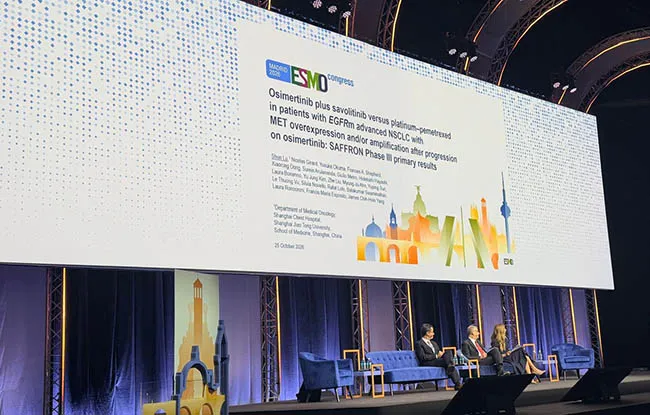
The findings of the SAFFRON phase 3 study, in which Institut Curie played a major role, confirm the efficacy of an adaptive medicine strategy in certain types of non-small cell lung cancer (with EGFR mutation and MET alteration*).
Once resistance to anti-EGFR targeted therapy emerges, adding an anti-MET medicinal product can reduce the risk of death by one-third and halve adverse effects in patients. Presented in a presidential session at the ESMO congress on October 25, 2026, these results are also the subject of a publication in the New England Journal of Medicine.
"These studies illustrate the effectiveness of an adaptive medicine strategy, at the heart of Institut Curie's priorities. By exploring, for the first time, the possibility of overcoming resistance to targeted therapy and directly blocking the resistance mechanism itself, rather than automatically switching to chemotherapy, the clinical impact of the SAFFRON clinical study is crucial for patient management," states Professor Nicolas Girard, a pulmonologist, Head of the Medical Oncology Department at Institut Curie, and person in charge of lung cancer programs at ESMO.
Lung cancer is one of the most common and serious cancers in both men and women. More than 80% of patients have non-small cell lung cancer, and among them, 10% to 15% have a mutation in the gene encoding the Epithelial Growth Factor Receptor (EGFR). These patients receive first-line treatment with a therapy specifically targeting EGFR (osimertinib). In 34% of cases, tumor cells evade osimertinib through MET overexpression and/or amplification, a receptor with tyrosine kinase activity.
An unpublished study of adaptive medicine in lung cancer
In this context, the Phase 3 SAFFRON study evaluates the clinical benefit of a combination – after failure of osimertinib alone – of two targeted therapies: the EGFR inhibitor (osimertinib) with the MET inhibitor (savolitinib), without the addition of chemotherapy. In total, 338 patients were randomized into the study: 171 received the EGFR and MET inhibitor, while 167 received standard chemotherapy alone.
The initial findings reveal the efficacy of simultaneously blocking EGFR and MET to bypass acquired resistance to anti-EGFR without immediately resorting to chemotherapy. The study shows a statistically and clinically significant improvement in progression-free survival and overall survival for patients after the onset of osimertinib resistance. This combination of two targeted therapies reduces the risk of death by 32% relative to standard chemotherapy.
In conclusion, the initial results of the SAFFRON study highlight a new effective therapeutic option, administered orally, and guided by biomarkers, leading to a new worldwide standard of care for patients with advanced non-small cell lung cancer with an EGFR mutation, presenting MET gene overexpression and/or amplification.
*Mutations in the EGFR gene (encoding the Epithelial Growth Factor Receptor) and alterations in the MET gene are key genetic abnormalities primarily studied in non-small cell lung cancer (NSCLC). They play a major role in tumor growth and treatment resistance.
Osimertinib (osi) + savolitinib (savo) vs. platinum–pemetrexed (plat–pem) in EGFRm MET-overexpressed (OE) and/or -amplified (AMP) advanced NSCLC post-osi: SAFFRON Phase (Ph) 3 primary results.
Professor Nicolas Girard, 2nd author – Proffered Paper session – European Society for Medical Oncology, Presidential Symposium – October 25, 2026
New England Journal of Medicine https://www.nejm.org/doi/full/10.1056/NEJMoa2611335