- Home >
- Institut Curie News >
- Drs. Allison Bardin and Sarah Watson Honored by the French Academy of Sciences
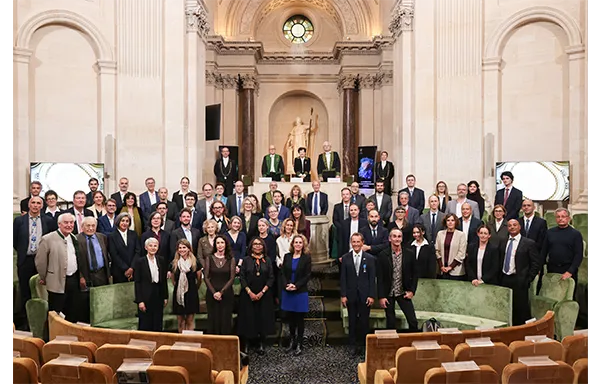
On October 27, 2026, Drs. Allison Bardin and Sarah Watson were honored by the French Academy of Sciences during an awards ceremony held beneath the Dome of the Institut de France. The two distinctions recognize their contributions to research, from understanding the fundamental mechanisms of life to applying artificial intelligence to cancer care.
Dr. Allison Bardin, Molecular and Cellular Biology, Genomics Medal
Understanding how tissues renew themselves while maintaining their balance is one of the central questions driving the research of Allison Bardin, CNRS Research Director and head of the Stem Cells and Tissue Homeostasis team (CNRS UMR3215/Inserm U934/Sorbonne Université) at Institut Curie.
Together with her team, she investigates the mechanisms that regulate stem cell function, proliferation and differentiation into specialized cells, as well as the maintenance of genome integrity. Using the fruit fly Drosophila, a genetic model particularly well suited to studying these processes, her research seeks to better understand how tissues maintain their balance over time and what factors can disrupt it. This fundamental knowledge is essential to understanding the principles and mechanisms that govern living systems, as well as shedding light on the biological processes involved in aging and certain diseases, including cancer.
“Receiving an award from the French scientific community, from researchers I consider leaders in their fields, is particularly meaningful to me. This work was made possible thanks to the support of Institut Curie and our Department of Genetics and Developmental Biology, which provide an exceptional scientific environment that fosters discovery,” says Allison Bardin.

Dr. Sarah Watson, Léon Alexandre Étancelin Prize
Sarah Watson, oncologist, physician-scientist and head of the Drug Development and Innovation (D3i) Department, was recognized for her work on cancers of unknown primary (CUP), rare cancers whose site of origin cannot be identified, making treatment decisions particularly challenging. Together with her collaborators, she developed an artificial intelligence (AI) tool to improve their diagnosis and care.
Initially developed in an academic research setting, the tool was subsequently integrated into a nationwide care network, whose evaluation demonstrated a survival benefit for patients.
“What makes me particularly happy is seeing that research can be recognized not only for its scientific advances, but also for its clinical applications. We have the opportunity to develop tools that make a real difference in patients’ lives, and having that recognized by fellow scientists is incredibly rewarding,” says Sarah Watson.
Her research into the clinical applications of artificial intelligence also includes her involvement in AGORA, a project supported by the Curie Audace call for proposals. Based on a multi-agent AI approach, the project explores new ways to help guide treatment decisions for patients with metastatic cancers who have exhausted standard treatment options, while also improving our understanding of the mechanisms of treatment resistance.