- Home >
- Institut Curie News >
- From canine odorology to electronic noses: a new way to detect breast cancer
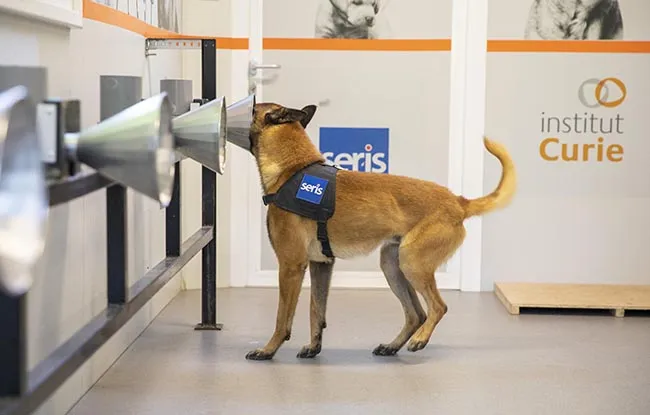
Are dogs able to "smell" cancer? Could their sense of smell help detect breast cancer? This is the whole point of an original project called KDOG and initiated at Institut Curie in 2016. Published in Nature Communications on November 27, 2025, the results of the KDOG1 clinical trial reveal that although dogs can detect breast cancer in sweat samples from women, the level of accuracy remains insufficient for clinical use. However, this work paves the way for the identification of the molecular signature detected by dogs, with a view to developing early breast cancer screening methods that are easy and accessible to all.
With more than 60,000 new cases each year in France, breast cancer is the leading female cancer and the leading cause of cancer mortality in women. At Institut Curie, in particular through the Women's Cancer Institute co-founded with Inserm and PSL University, the teams are strongly mobilized to improve diagnosis, ensure appropriate support for each patient and strengthen the prevention of breast cancer.
In France, organized breast cancer screening - which consists of a mammogram and a clinical examination - makes it possible to detect the disease at an early stage and in this case, this cancer is cured 9 times out of 10. However, less than one woman in two participates (48.2% over the 2023 period)1. If the deployment of mammography has allowed undeniable advances in the fight against breast cancer, alternative solutions are developing today; like the KDOG project.
KDOG, a new adventure born in 2016 at Institut Curie
Launched in 2016 at the instigation of Dr. Isabelle Fromentin, nurse researcher and head of the wounds and healing unit of Institut Curie, KDOG is a research and medical innovation program for breast cancer screening based on canine odorology. Its objective: to develop a simple, inexpensive and non-invasive screening technique. "Our ambition is to develop alternative and complementary screening approaches, to reduce inequalities in access to mammography and to produce a major collective impact on women's health around the world" explains Isabelle Fromentin.
In 2017, the KDOG team validated a proof of concept : 2 trained dogs managed to detect 90.3% of the positive samples (from women with breast cancer) among the 130 sweat samples presented to them. At each test, the dogs were confronted with 4 sweat samples from women, of which only one was positive. On the basis of this preliminary work, the teams of Institut Curie have developed a clinical trial: KDOG1.
KDOG1 : encouraging results for the future of odor detection
KDOG1 is a Phase 2 clinical trial, funded by a hospital Clinical Research program. Started in 2020, this study was conducted with 181 women: the participants had to apply a compress to their breasts for 6 to 12 hours. Then, these sweat-soaked compresses were presented to the two dogs in the study, for the training and test phases.
"The task faced by the 2 dogs during this clinical trial was much more complex than that in the pilot study, in order to reflect conditions closer to the reality of screening. Several positive samples, or on the contrary, that negatives could be presented to the dogs," specifies Isabelle Fromentin. It is precisely in these more complex situations and over a much longer period that the dogs encountered difficulties in distinguishing the positive samples. The results of the KDOG1 study show that 80% of the positive samples were identified by at least one of the dogs, but only 49% by both, showing limited accuracy. "Today we are publishing important results: dogs are indeed able to detect cancer in women's sweat, as our preliminary study already showed. But to be used in the clinic, it is necessary to obtain a level of precision that the dogs did not reach in KDOG1," says Isabelle Fromentin.
Towards an electronic nose?
However, these results show that there is a detectable molecular signature in perspiration, opening up an innovative perspective: the identification of this signature by chemical-analysis. "We don't know what volatile organic compounds (VOCs) are perceived by dogs in the patients' samples. If we can determine which ones are associated with cancer, we could potentially develop "electronic noses", capable of a sufficient level of accuracy for screening. It would also improve dog training protocols: by using only the VOCs identified during the learning phases, we could perhaps increase the detection accuracy," adds Dr. Isabelle Fromentin.
"I am proud of our work: not only are our results exploited by other research teams, but they could also be applied to other types of cancer. Our objective here is the development of minimally invasive screening and diagnostic techniques that are accessible to as many people as possible, complementary to mammography, " concludes Isabelle Fromentin.
[1] Sources INCa and Public Health France : https://www.santepubliquefrance.fr/les-actualites/2024/depistage-du-cancer-de-sein-encore-trop-peu-de-femmes-se-font-depister
Photo ©SERIS-KDOG
Reference: Tardivon, A., Mesurolle, B., Dureau, S. et al. A prospective trial for breast cancer diagnosis by canine odorology. Nat Common 16, 10650 (2025). https://doi.org/10.1038/s41467-025-65655-6