- Home >
- Institut Curie News >
- Dr. Raphaël Rodriguez awarded the Senate Medal
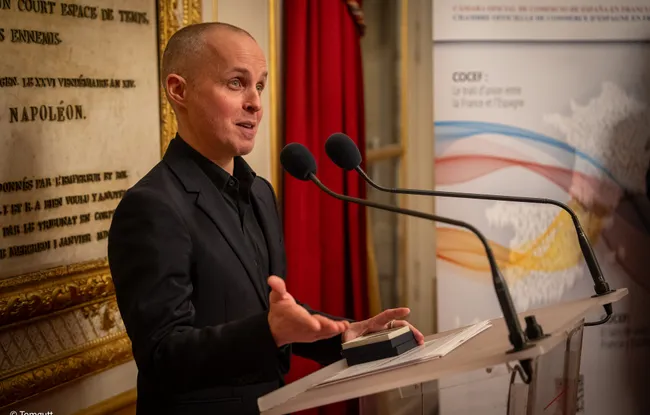
On February 18, Dr. Raphaël Rodriguez, CNRS Research Director, Deputy Director of a research unit and research team leader at Institut Curie, received the Senate Medal, presented by the Official Spanish Chamber of Commerce in France (COCEF) and the France-Spain Friendship Group of the Senate. This distinction recognizes his work on the epigenetic control of cellular adaptation in cancer and the development of new therapeutic approaches.
“This medal is one I receive on behalf of the team. It reflects collective work built over several years, with committed collaborators and loyal supporters,” said Dr. Raphaël Rodriguez at the end of the ceremony.
On February 18, in the Salon Napoléon at the Palais du Luxembourg, COCEF and the France–Spain Friendship Group of the Senate presented him with the Senate Medal. Each year, these institutions choose to highlight a specific field. After gastronomy in 2023 and Paralympic sports in 2024, the 2025 edition was dedicated to medical research. Dr. Raphaël Rodriguez was honored for his work on metastatic cancers.

A CNRS Research Director, Deputy Director of the Chemical Biology of Cancer unit (Inserm U1339 / CNRS UMR3666), and head of the Biomedicine team within this unit at Institut Curie, Dr. Raphaël Rodriguez conducts research at the intersection of chemistry and biology. His work focuses on the mechanisms that enable cancer cells to alter their state, adapt, and resist treatment.
His team has notably demonstrated the role of iron and copper in epigenetic regulation, meaning the chemical mechanisms that control gene expression without altering DNA. By modulating these balances, tumor cells can change behavior and become more aggressive or more resistant.
This research led to the design of a new class of molecules capable of inducing ferroptosis, a form of iron-dependent cell death characterized by the oxidation of membrane lipids. The aim is to target cancer cells that have become tolerant to conventional therapies. These results, published in May 2025 in the journal Nature, received wide coverage in the national press, notably in Le Monde and L’Express.
“Understanding the mechanisms of cellular adaptation is essential if we want to propose truly new strategies in oncology,” he added.