- Home >
- Institut Curie News >
- Dr. Sarah Watson recognized among the 2026 Next Gen Leaders in Health
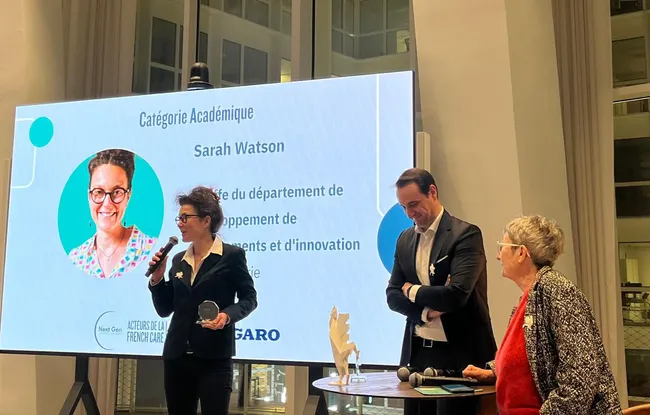
Dr. Sarah Watson, medical oncologist specializing in sarcomas, researcher and head of the Drug Development and Innovation (D3i) department at Institut Curie, has been selected among the 2026 Next Gen Leaders in Health in the “Academic Research” category. This distinction, awarded by the Acteurs de la French Care association, notably recognizes her work aimed at better understanding and treating cancers of unknown primary through data analysis and artificial intelligence.
Each year, the Acteurs de la French Care association recognizes ten French talents under the age of 45 who are contributing to advancing medicine and healthcare systems. The initiative aims to highlight a new generation of researchers, physicians, and entrepreneurs expected to play a major role in tomorrow’s medical innovations, while fostering synergies among the different actors within France’s health ecosystem. For the 2026 edition, the jury selected Dr. Sarah Watson in the “Academic Research” category.
Alongside her clinical activities and leadership of the Drug Development and Innovation (D3i) department at the hospital, Dr. Sarah Watson conducts research within the Biomedicine team (Inserm U1339 / CNRS UMR3666) at the Research Center, aiming to better understand certain cancers that remain poorly characterized. Her work focuses in particular on cancers of unknown primary, a metastatic cancer for which the tumor of origin cannot be identified at the time of diagnosis. These cancers affect around 6,000 new patients each year in France and are generally associated with an unfavorable prognosis.
To better understand these tumors and improve patient management, Dr. Sarah Watson developed TransCUPtomics, an artificial intelligence tool capable of identifying the tumor origin from transcriptomic data. The hypothesis underlying this approach is that metastases retain the molecular signature of the tumor from which they originate. Analyzing these signatures using deep learning algorithms makes it possible to guide patients toward more appropriate targeted treatments.
To date, nearly 500 patients have benefited from this approach. The tool is now deployed in routine clinical practice within the framework of the national multidisciplinary tumor board on cancers of unknown primary, coordinated at the national level by Institut Curie. This forum brings together specialists from across France to review patient cases and discuss treatment strategies. In more than 70 percent of cases, the analysis made it possible to determine the cancer’s origin, transforming a situation of diagnostic uncertainty into a personalized therapeutic strategy. Its use in routine care is also associated with a significant increase in patient survival.