- Home >
- Institut Curie News >
- Institut Curie Receives Two Awards from the BMS Foundation
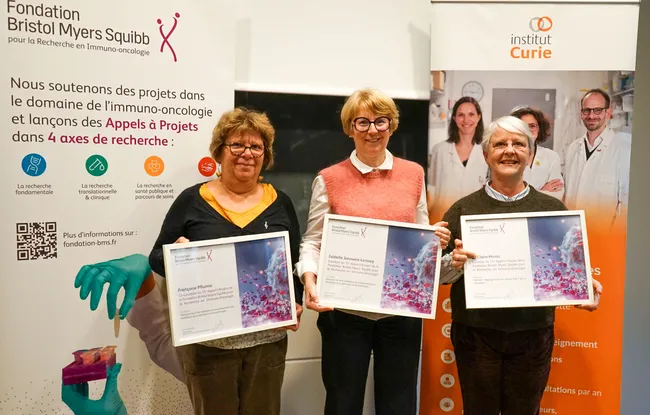
Drs. Claire Hivroz and Isabelle Janoueix-Lerosey, group leaders at Institut Curie, are winners of the 15th edition of the Bristol Myers Squibb Corporate Foundation's call for projects. This program supports innovative immuno-oncology projects aimed at advancing research and improving the care of patients with malignancies. This recognition underlines the excellence and the innovative potential of the work carried out at Institut Curie and provides decisive support to develop new therapeutic strategies for the benefit of patients.
Two Institut Curie projects are among those selected in the 15th edition of the Bristol Myers Squibb Foundation’s call for proposals. This programme supports innovative immuno-oncology initiatives aimed at advancing research and improving patient care and quality of life. “Over the past ten years, BMS has supported multiple projects with a total of €1.3 million in funding, demonstrating its valued trust in our teams and their work. We share a common ambition: to generate discoveries that may one day benefit patients. This recognition illustrates the essential role of public–private partnerships in accelerating research and developing the therapeutic innovations of tomorrow,” says Dr. Cécile Campagne, head of Institut Curie's Technology transfer office and deputy director of Carnot Curie Cancer.
Paediatric cancers: unravelling the bone marrow niche in metastatic neuroblastoma to optimise immunotherapy
Dr. Isabelle Janoueix-Lerosey, an Inserm research Director and head of the Biology and oncogenesis of neuroblastoma team at Institut Curie, has been recognised for her project investigating interactions between neuroblastoma cells and their environment in the bone marrow. Initiated within the Paris Kids Cancer consortium, the project is being conducted in close collaboration with Dr Françoise Pflumio, an Inserm research director and research team leader1 at CEA. Neuroblastoma is the most common extracranial solid malignancy in children. Often diagnosed at a metastatic stage, with survival rates below 50% for high-risk disease, this childhood cancer requires more effective therapeutic options. The bone marrow is affected in more than 90% of metastatic cases, which are associated with a very poor prognosis and resistance to treatment.
Although immunotherapies targeting GD2, a molecule found on the surface of tumour cells, have improved care for some patients, their effectiveness remains limited. Several lines of evidence suggest that the tumour microenvironment plays a key role in immune evasion. “We want to understand why tumour cells preferentially invade the bone marrow, and then how they adapt to and interact with this new environment, the bone marrow niche,” explains Dr Isabelle Janoueix-Lerosey. “Neuroblastoma is a particularly heterogeneous cancer, and this complexity needs to be deciphered cell by cell through an integrative approach combining genetics, transcriptomics and modelling.”
To explore these interactions in the bone marrow, the project uses innovative models of “humanised mini-bones”, known as ossicles, which recreate functional human bone marrow. These models are developed by Dr Françoise Pflumio’s team at the CEA. They will enable researchers to study how neuroblastoma cells establish themselves and grow within the marrow, characterise their properties and analyse the changes tumour cells induce in the various bone marrow cell populations.
“By combining these innovative models with several techniques for analysing cells and their gene expression, this research aims to identify new therapeutic targets. In the longer term, it could help improve the effectiveness of immunotherapies and open up new treatment possibilities for young patients with neuroblastoma,” the researcher concludes.
MECAR-T: harnessing cell mechanics to improve immunotherapies
CAR T cells, immune cells engineered to recognise and attack cancer cells, have transformed the treatment of certain cancers. However, their effectiveness remains limited when tumour cells express lower levels of the markers they target or when the surrounding environment becomes unfavourable. Led by Dr. Claire Hivroz, an Inserm Research Director and head of the Analysis of T Cell Activation team at Institut Curie, the MECAR-T project explores an under-investigated approach to overcoming these obstacles: improving the ability of CAR T cells to sense and respond to the mechanical properties of tumour cells.
As cancer progresses, the tumour’s physical properties change: the network surrounding the cells may stiffen, while the cancer cells themselves sometimes become softer. “These changes could create a mechanical barrier to immune cell activity and promote tumour escape,” says Dr Claire Hivroz. The team has also shown that CAR T cells are sensitive to the stiffness of their targets.
While strategies to improve CAR T cells focus primarily on biochemical signals, MECAR-T aims to harness their mechanical sensitivity. “CAR T cells are also sensitive to the mechanical properties of the cells they encounter. With MECAR-T, we are seeking to understand how these properties influence their ability to attack cancer cells. Our ambition is to design CAR T cells that are better adapted to the physical constraints of tumours, enhancing their effectiveness, particularly against solid tumours,” explains Dr Claire Hivroz.
[1]UMR008/U1274