- Home >
- Institut Curie News >
- Dr. Matthieu Piel joins the French Academy of Sciences
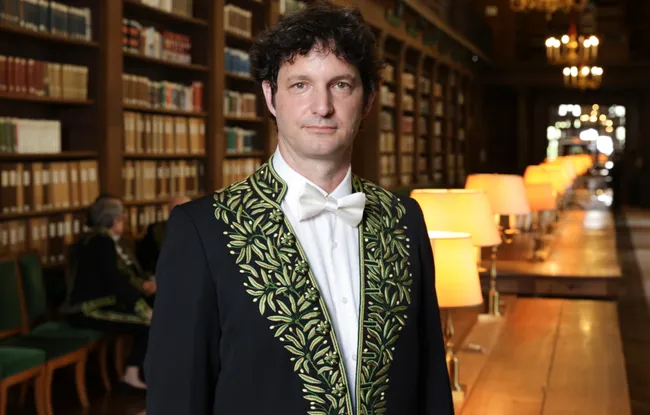
CNRS Research Director and research team leader at Institut Curie, Dr. Matthieu Piel was officially welcomed to the French Academy of Sciences during the reception ceremony for new members, held on June 2, 2026, under the dome of the Institut de France. This distinction recognizes pioneering work at the interface between physics and cell biology, which has notably revealed the role of physical constraints in the behavior of immune and cancer cells.
“First and foremost, it is a feeling of pride,” says Dr. Matthieu Piel. “You feel recognized by the scientific community, in a fairly official way. The French Academy of Sciences is an important institution, with truly outstanding scientists. Realizing that you are now part of it is inevitably meaningful, especially as I really was not expecting it.”
These words capture the researcher’s state of mind as he joins the French Academy of Sciences. CNRS Research Director and head of the Quantitative Physiology of the Cell team (CNRS UMR144 / Sorbonne University) at Institut Curie, Dr. Matthieu Piel has built his career around a central question: how do cells live, move, divide and adapt when they are subjected to physical constraints?
His work has notably shown how confinement, meaning the passage of cells through very narrow spaces within tissues, influences the behavior of immune and cancer cells.
It has helped bring about an integrated vision of cell biology, in which mechanics, cell architecture and biological function are closely linked.
“I see myself as a biologist who uses tools from physics to answer questions in biology,” explains Dr. Matthieu Piel.
This approach has enabled his team to explore how cells respond to physical constraints, particularly when they migrate through dense tissues, where they are compressed by their environment. Among his major discoveries are ruptures of the nuclear envelope: nuclei can break mechanically under the effect of forces exerted by cells, and then be repaired, with sometimes significant consequences for their behavior. In tumors, for example, these ruptures can promote the emergence of more invasive cells.
This interdisciplinary perspective was shaped at Institut Curie, where Dr. Matthieu Piel first arrived in 1995, in Dr. Michel Bornens’ laboratory. Trained as a physicist, he discovered cell biology there before completing his PhD. After spending time in the United States, he chose to return to Institut Curie to create his team in 2007, convinced that he would find a unique scientific environment there.
“Almost none of the projects I have carried out would have been possible alone,” he emphasizes. “At Institut Curie, I have always had access to this whole spectrum, from biologists to physicists, in a spirit of collaboration and sharing that is quite unique.”
Today, his team is exploring new avenues linking cell biology, health and environmental challenges, particularly around the impact of microplastics on immune cells. This direction echoes a broader conviction: for Matthieu Piel, science makes it possible to move beyond assumptions, to question “things we think we know without really knowing them,” and can contribute to a form of “collective emancipation.”