- Home >
- Institut Curie News >
- Movember 2026 : Institut Curie accelerates innovation to better treat men's cancers
Cancers that specifically affect men account for over 63,000 new cases per year in France, with prostate cancer being the most common. At Institut Curie, doctors and researchers are engaged daily in the fight against male cancers with innovative research programs and increasingly personalized care, particularly thanks to cutting-edge radiotherapy. Movember, a month for raising awareness about men's health, is an opportunity to take stock.
The most frequent is prostate cancer, with nearly 60,000 cases recorded in 2018 in France. Generally rare before age 50, its prognosis is favorable if diagnosed early. It remains 3rd in number of deaths.
In contrast, testicular cancer primarily affects young men (2,769 new cases in 2018). With an increasing incidence, its prognosis remains relatively optimistic. With early diagnosis, this cancer can be treated with the least aggressive treatments. Today, efforts are focused on improving chemotherapy protocols and therapeutic selection criteria for advanced and metastatic cancers.
As for penile cancer, it is the rarest with nearly 450 cases reported in 2018. It mainly affects older men, and its prognosis is less favorable. Source: French National Cancer
Source : Institute INCa

Increasingly personalized prostate cancer care
For patients with prostate cancer, the standard treatments are radiotherapy, surgery, curietherapy1 and hormone therapy.
One of the challenges in management is to preserve this gland of the male reproductive system to avoid the risks of urinary incontinence and sexual dysfunction. This is possible when the cancer is very localized, and in that case, radiotherapy (or curietherapy) is the preferred treatment.
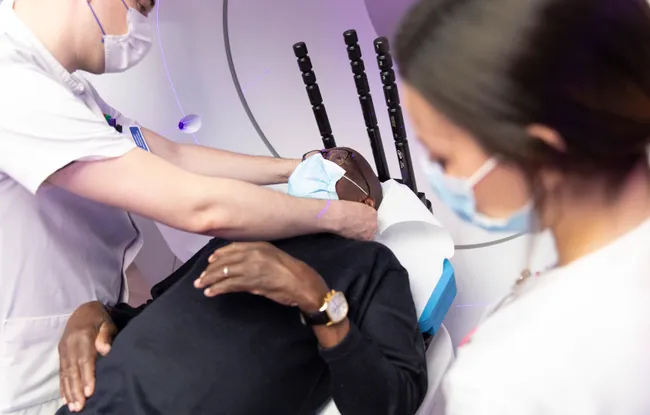
With 15 treatment rooms (6 in Paris, 5 in Saint-Cloud, and 4 in Orsay), Institut Curie has the most complete radiotherapy technical platform in Europe. All types of radiotherapy are practiced there. Over 97,000 radiotherapy sessions are performed every year at the institute.
Stereotactic radiotherapy2 is a new therapeutic option for localized prostate cancer in patients who have not undergone surgery. This is a very high-precision radiotherapy technique that allows for the administration of high doses of radiation while preserving healthy tissues. The dose needed for healing can thus be concentrated into a few sessions, instead of being spread out daily over several weeks. It includes 5 sessions delivered every other day, over 2 weeks. It is also effective, with toxicities similar to conventional radiotherapy. By 2027, Institut Curie plans to benefit patients with non-operated localized cancer (80% of cases).
Stereotactic radiotherapy and vectorized internal radiotherapy are booming for treating relapses and metastatic forms
In more than 80% of cases, these cancers are localized at diagnosis and accessible to treatment, which may include surgical removal of the prostate (radical prostatectomy).
Despite surgery, cancer cells may have already spread beyond the prostate capsule or invaded the fat or lymph nodes around the prostate, inevitably leading to recurrence in 10% to 50% of cases over 10 years.
Salvage radiotherapy of the at-risk areas allows for relapse-free survival in 75% to 85% of cases. This catch-up treatment is standard, sometimes supplemented by 6 months of hormone therapy. Radiotherapy is delivered over 6.5 to 7.5 weeks in 33 to 37 consecutive sessions, administered Monday through Friday, which results in a significant burden for patients, mental fatigue, and possible side effects during radiotherapy, to be endured during the latter half of the treatment.
To date, stereotactic radiotherapy does not apply to patients operated on for relapse, who remain the only ones unable to benefit from this cutting-edge technique as a routine treatment.
After several conclusive preliminary studies, the French HyPORT-01 trial, coordinated by Professor Pr Gilles Créhange at Institut Curie, will be the first randomized trial to compare radiotherapy in 33 sessions (standard treatment) to stereotactic radiotherapy in 5 sessions (experimental treatment) in patients operated on for relapse.
This study plans to include 450 patients in 35 French centers, experienced in stereotactic radiotherapy, over 3 years. The main objective of this study is to demonstrate that treatment in 5 sessions offers the same therapeutic benefit as treatment in 33 sessions without significant toxicities. The study opening is scheduled for the 2nd semester of 2027.
“This study should allow stereotactic radiotherapy to be offered to patients who have relapsed after surgery in the medium term. This will have a very positive impact on patients' quality of life, as well as significant medico-economic impacts.” explains Professor Gilles Crehange, Head of the Radiotherapy Oncology Department at Institut Curie.
Internal targeted radiotherapy (or RIV), which is also among the therapeutic options for metastatic prostate cancer, is booming. Unlike conventional external radiotherapy, this nuclear medicine technology consists of intravenous injections of radiopharmaceutical molecules that specifically bind to tumor cells to destroy them.
Institut Curie, a global pioneer in digital pathology
For over three years, pathology has been 100% digital at Institut Curie: all slides from new patient tumor samples are digitized. The benefits are numerous, including: the use of artificial intelligence tools to refine diagnosis and facilitate therapeutic choices, but also to develop research projects. Institut Curie is among the first university laboratories in the world to use these AI solutions in pathology: for over a year, Institut Curie teams have routinely used AI for prostate cancer diagnosis. “The implementation of these tools in our department allows our teams to save time, improve the reliability of our results, target areas of interest, and enhance the accuracy of our diagnoses, without replacing physicians,” specifies Professor Pr Yves Allory, a physician in the pathology department at Institut Curie, Saint-Cloud site, and head of a research team in the IRIS (Innovative Radiotherapy Imaging and Systems Medicine) unit (Inserm/CNRS/University of Versailles Saint Quentin/Institut Curie).
Towards less invasive diagnostic methods
Today, there is no systematic screening for prostate cancer. It is the appearance of symptoms, such as difficulty urinating, that leads to screening by measuring prostate-specific antigen (PSA). Depending on the results, patients must undergo a biopsy, a painful and anxiety-inducing procedure. A great deal of research effort is directed towards developing less invasive methods to improve patients' quality of life during these early stages.
Thus, among the research avenues at Institut Curie, a project on MRI imaging is led by Professor Yves Allory and Dr. Fanny Orlhac, a researcher within the Innovative Imaging, Radiotherapy, and Systems Medicine Laboratory (Inserm/CNRS/University of Versailles Saint-Quentin/Institut Curie) directed by Dr. Irene Buvat. The objective of this project is twofold. "The first objective is to develop a method for precisely identifying, from MRI imaging data, the site to biopsy in the prostate." "Today, to maximize the probability of properly biopsying the area affected by cancer, the needle takes samples from several different locations (generally more than 5, sometimes around ten), a stressful and uncomfortable procedure for patients," explains Dr. Irène Buvat.
Identifying the area to be biopsied using imaging, already used in other types of cancer, would simplify this invasive procedure while ensuring the relevance of the sample taken to determine the disease. The second objective of this ambitious project is to identify an MRI signature of cancers, using several measures achievable by MRI. In the long term, this work could make it possible to avoid physical biopsy, and thus perform a virtual biopsy by MRI.
Other cancers that primarily affect men: kidney, bladder
Kidney cancer
The number of new cases of kidney cancer in France in 2018 was estimated at 15,323, with 67% occurring in men. This cancer, which affects men twice as much as women, is sharply increasing. "For kidney cancer, the identified risk factors are mainly obesity and metabolic disorders, as well as tobacco to a lesser extent. The treatments offered are now a combination of immunotherapy or immunotherapy combined with anti-angiogenic therapy," explains Dr. Mostefa Bennamoun, medical oncologist at Institut Curie. Stereotactic radiotherapy is also under development for this location (3 sessions). Minimally invasive, with little toxicity, this technique allows for complete local tumor control at 5 years.
Bladder cancer
An estimated 13,000 new cases of invasive bladder cancer were diagnosed in France in 2018, 81% of which were in men. " Today we know that the main risk factor for bladder cancer is tobacco use. This could explain the predominant involvement of men, even if these trends are reversing today, as has been the case for lung cancers," explains Dr. Mostefa Bennamoun. In the case of aggressive localized or metastatic cancer, the standard treatment has changed very recently. Patients now receive immunotherapy combined with an antibody-drug conjugate that delivers the medication directly to the tumor, with greater effectiveness.
As part of the recovery of Montsouris Institute (IMM) by Hopital Foch and Institut Curie, since November 1, 2025, strengthening collaborations in urology is a priority. The Curie-IMM Institute of Onco-urology, dedicated to urological cancers and set to launch in November 2026, will offer patients targeted, streamlined, and integrated care pathways across the entire Ile-de-France region, while enhancing their access to therapeutic innovations and clinical trials. It relies on the great complementarity of expertise between the two institutes.
[1] Curietherapy is a radiation technique that involves placing a strong radioactive source near or inside a tumor.
[2] Stereotactic radiotherapy is a highly precise radiotherapy technique that is increasingly favored for treating localized cancers. By converging multiple beams on a small volume, it makes it possible to irradiate the tumor at a high dose while limiting the irradiation area in order to spare the surrounding healthy tissues.