- Home >
- Institut Curie News >
- Lung cancer: adaptive oncology at the heart of Institut Curie's work, for better patient care
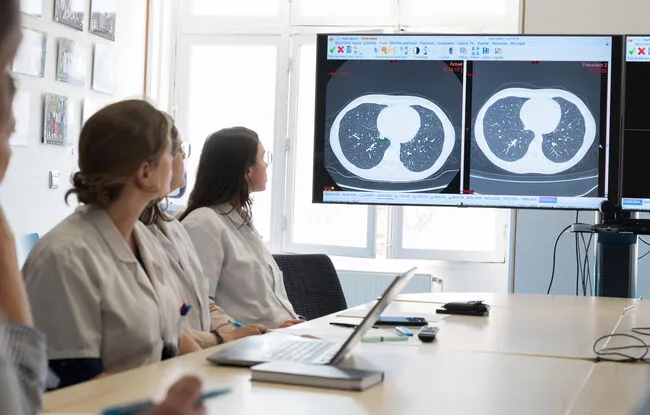
Results of lung cancer studies involving teams from Institut Curie will be presented at the 2026 ESMO Congress. Among them, the results of a major study could have a crucial clinical impact on the treatment of certain non-small-cell lung cancers.
Overcoming treatment resistance by combining two targeted therapies: towards a change in practice for certain lung cancers
Results of the SAFFRON study in a presidential session
Lung cancer is one of the most common and serious cancers in both men and women. More than 80% of patients have non-small cell lung cancer (NSCLC), and among them, 10% to 15% have a mutation in the gene encoding the epidermal growth factor receptor (EGFR). These patients receive first-line treatment with a therapy specifically targeting EGFR (osimertinib). However, in 34% of cases, tumor cells evade osimertinib via MET overexpression and amplification, a receptor with tyrosine kinase activity. In this context, the Phase 3 SAFFRON study evaluates the clinical benefit of a combination – after osimertinib failure – of two targeted therapies: the EGFR inhibitor (osimertinib) with the MET inhibitor (savolitinib), without chemotherapy. The study's objective is thus to show that by blocking EGFR and MET at the same time, it becomes possible to control the disease and prolong patient survival. The first survival results from the SAFFRON study, in which Institut Curie participated extensively, will be presented in a presidential session, and could have major clinical implications.
"These studies illustrate the effectiveness of an adaptive medicine strategy, at the heart of Institut Curie's priorities. By exploring for the first time the possibility of overcoming resistance to targeted therapy by directly blocking the resistance mechanism itself, rather than automatically switching to chemotherapy, the clinical impact of the SAFFRON study is crucial", states Prof. Nicolas Girard, a pulmonologist, Head of the Medical Oncology Department at Institut Curie, and head of lung cancer programs at ESMO.
An original study to understand the mechanism of action and adaptation of antibody-drug conjugates
A new class of drugs, antibody-drug conjugates are complex molecules combining an antibody capable of binding to tumor cells with a chemotherapy anticancer agent. Already used in several different types of cancers, their advantage is powerful: by targeting only cancer cells, they deliver chemotherapy solely to tumor cells and spare healthy cells.
A team from Institut Curie explored the mechanism of action of these antibody-drug conjugates. To do this, researchers analyzed the genetic and gene expression of certain subgroups of patients recruited for the TROPION Lung01 study, a clinical trial evaluating a drug-antibody conjugate: datopotamab deruxtecan, in patients with advanced or metastatic non-small cell lung cancer.
For the very first time, researchers have investigated the question of cancer cell sensitivity (or lack of) to the antibody's target at the same time as sensitivity to the chemotherapy carried by the antibody. "Conceptually, this adaptive medicine approach allows for the integration of the complexity of antibody-drug conjugates into study design. While most studies examine tumor targets, our work shows the importance of evaluating chemotherapy sensitivity in order to optimize the therapeutic efficacy of these innovative drugs," concludes Prof. Girard.
Osimertinib (osi) + savolitinib (savo) vs platinum–pemetrexed (plat–pem) in EGFRm MET-overexpressed (OE) and/or -amplified (AMP) advanced NSCLC post-osi : SAFFRON Phase (Ph) 3 primary results. Pr Nicolas Girard, 2e auteur – Proffered paper session
Les résultats de l’étude SAFFRON seront présentées en session présidentielle et feront l’objet d’une publication concomitante dans le New England Journal of Medicine le dimanche 25 octobre 2026.
Mechanisms of insensitivity to the datopotamab deruxtecan (DatoDXd) payload in subgroups of patients with advanced non-small cell lung cancer (NSCLC) in TROPION Lung01 – Pr Nicolas Girard – Poster session Translational research and biomarkers