- Home >
- Institut Curie News >
- Extracellular matrix and immune infiltration: a new study from Institut Curie makes the connection
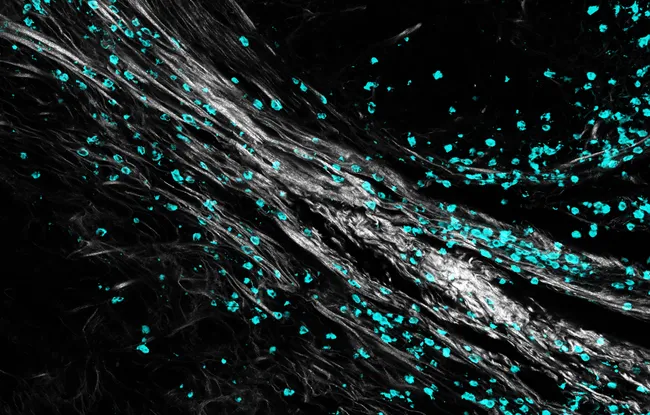
The extracellular matrix, the tissue scaffold in which our cells reside, is deeply remodeled in tumors. A new study led by Dr Hélène Moreau, Inserm researcher at the Immunity and Cancer unit (Inserm U932) at Institut Curie, shows that the structure of this matrix makes it possible to predict the infiltration of the tumor by immune cells. Regarding this infiltration aimed at destroying the cancer cells, these results, published in Science Immunology on March 20, 2026, open research prospects to improve the effectiveness of immunotherapies.
The cells of our organism are organized into tissues, the organization of which is strongly influenced by the extracellular matrix. It contains different components, including collagen, and plays an essential role in different cellular functions such as migration. Numerous studies have demonstrated that in tumors, the extracellular matrix changes. "Our objective was to understand how the structure of the extracellular collagen matrix impacts certain characteristics of tissues, such as the distribution of immune cells," explains Dr. Hélène Moreau, Inserm research associate in the team Spatio-temporal dynamics of the cells of the immune system (Inserm U932) at Institut Curie directed by the Dr. Ana-Maria Lennon-Duménil, Inserm research director.
The collagen capsule
"We started by trying to understand how the structure of the extracellular collagen matrix is regulated in tumors, " specifies Dr. Hélène Moreau.
There is a collagen capsule in tumors whose fibers are very aligned, in which the immune cells are frequently trapped.
In order to understand how this collagen capsule is formed, the researchers suppressed a population of immune cells—macrophages. Under these conditions, the collagen capsule becomes chaotic, allowing immune cells to infiltrate the tumor.
"We have therefore shown that macrophages are involved in the structuring of the extracellular matrix,"concludes Dr. Hélène Moreau.
To decipher the action of macrophages in the remodeling of the matrix, the researchers analyzed the transcriptome of tumors by mathematical algorithms based on information theory, in collaboration with the team of Dr. Hervé Isambert, CNRS research director and head of the Computational Biology (CNRS UMR168 / Sorbonne University) at Institut Curie. This analysis made it possible to highlight that the macrophages inhibited the production of collagen 3, responsible for the chaotic organization of the network.
Topography and infiltration
Secondly, the team was interested in the consequences that the change in the structure of the extracellular matrix can have.
By collaborating with Dr. Sylvie Coscoy from the Physics of cells and cancer (CNRS UMR168 / Sorbonne University) and Vincent Semetey (Chemistry Paris), the researchers were able to 3D print fiber networks reproducing the structures observed in tumors. They were thus able to demonstrate that T lymphocytes use these fibers to move, and are thereby confined to the exterior of the tumor—much like on parallel rails. They cannot thus reach and destroy the tumor cells. On the other hand, by making the network chaotic, new routes are created, allowing T lymphocytes to infiltrate the tumor.
The researchers have developed algorithms for machine learning to predict the location of immune cells. The results show that the topographic organization according to the three-dimensional structure of the extracellular collagen matrix makes it possible to predict the location of immune cells, including T lymphocytes, in the tumor.
Towards a better effectiveness of immunotherapy?
The infiltration of the tumor by immune cells, and more specifically T lymphocytes, is one of the factors predicting the effectiveness of immunotherapy. Indeed, T lymphocytes are responsible for the elimination of tumor cells. "In this study, we succeeded in identifying a regulatory pathway for the structure of the extracellular matrix, and showed that it is predictive of the infiltration of the tumor by T lymphocytes. We are still at the stages of fundamental research, but these results open the way to a better understanding of mechanisms potentially exploitable in the clinic,"concludes Dr. Hélène Moreau.
These results were obtained with the participation of the Nikon Imaging Center and CurieCoreTech platforms Cell and Tissue Imaging and High-throughput Sequencing (ICGex).
References: Fuselier et al., Macrophages restrict tumor immune infiltration by controlling collagen topography, Science Immunology, March 20, 2026, doi: 10.1126/sciimmunol.adw8291